In January 2018, the first ‘Circularity Gap Report’ was launched at the World Economic Forum in Davos. Born out of the Dutch nonprofit impact organization, Circle Economy Foundation, the report showed that only 9.1 percent of the world economy was circular. Since then, figures have dropped to 7.2 percent, leaving very little space for hope in the 2023 and 2024 editions:
“Today, the world is 7.2 percent circular and at the brink of climate breakdown. If we double this rate, we will limit global warming to well below 2 degrees, enhance biodiversity, and create cleaner air. In a world that is 17 percent circular, climate catastrophe will be avoided”
In essence, when examining the circularity gap from a global standpoint, the world falls short by nearly 10 percent in reaching an acceptable level.
However, when focusing on a specific country like Denmark, a nation widely known for its stand on saving the planet, figures are even more disturbing (source).
Denmark’s economy is only 4 percent circular which is significantly lower than the circularity metric for the global economy, measured at 7.2 percent. Facts and figures commented, in short, in the CG Report by Magnus Heunicke, Danish Minister of the Environment:
“This report underlines the need to change our production and consumption patterns.”
The CG Report points to five pathways to double Denmark’s circularity rate:
- Embrace a circular lifestyle.
- Rethink transport and mobility.
- Nurture a circular food system.
- Advance circular manufacturing.
Finally, within the construction sector, which has the most significant impact and the biggest pathways to reduction, Denmark needs to: Build a circular built environment.
NO WAY AROUND THE CONSTRUCTION SECTOR
When digging into the CG Report on Denmark and talking to Ms. Samy Kazemi, Lead Built Environment at Circular Economy Foundation, there are similarities in the construction industry to be found among a number of European countries. The built environment is a major contributor to carbon and material use.
“The figures from the CG Report reconfirm that Denmark can’t be circular without involving the construction sector and built environment. It is such a massive sector, accounting for the largest amount of resources consumed and waste produced,” says Samy Kazemi.
The construction sector in Denmark is accounting for 17 percent of its carbon footprint. According to the ‘CG Report’, the expansion of the built environment which, for this analysis, includes residential and commercial buildings and excludes infrastructure, claims almost 32 percent of total material consumption. At the same time, construction is a crucial economic sector in Denmark, employing 6.2 percent of the country’s total workforce in 2022 (source).
THE INTERNATIONAL ENERGY AGENCY’S (IEA) SUSTAINABLE RECOVERY REPORT
The International Energy Agency’s (IEA) sustainable recovery report found that, per euro invested, building renovation is the biggest job creator, generating 12 to 18 local jobs for every million invested. By 2030, the EU Commission estimates the potential for an additional 160,000 green jobs in the construction sector in the EU.
“So not only in Denmark but all across Europe, is the building sector big and vital. But the circularity gap still forces the construction sector and the public sector to team up and find new solutions. If I may quote the American architect, inventor, and philosopher Buckminster Fuller: “In order to change the system, we have to create a new system!”, says Samy Kazemi.
Among a number of sectors that could help close the circularity gap, the CG Report for Denmark points at four “what if” intervention scenarios for the construction sector.
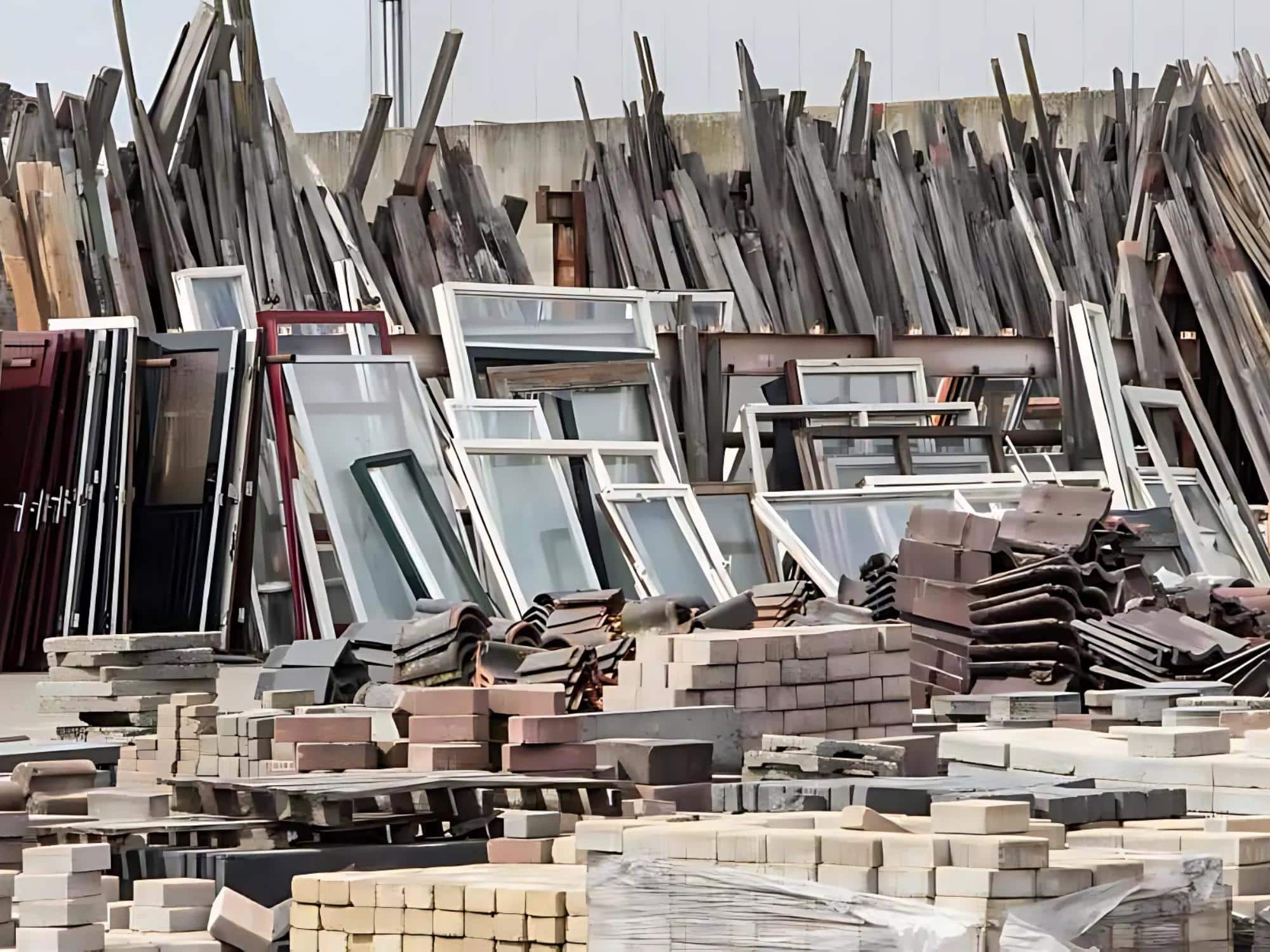
- Optimize housing stock expansion to lower the Danish construction industry’s material footprint by narrowing and cycling flows. For example, Denmark can use digital tools to manage construction and demolition waste. Reused building materials can be put to good use for new residential construction and maintenance. That could cut material footprint by 6.9 percent and carbon footprint by 3.6 percent. The circularity metric could grow by 0.56 percentage points, up to 4.56 percent.
- Ensure an energy-efficient housing stock and seek the possibility of improving existing buildings over demolition with the impact of deep retrofitting. This could narrow flows by reducing the energy required to heat homes through significant improvements in building insulation. In doing so, secondary, and non-toxic, regenerative materials should be prioritized to cycle and regenerate flows. A decrease in room temperatures of 2-degrees and the use of energy-efficient household appliances are also considered. Combined, this intervention could cut the material footprint by 5.7 percent, bringing it down to 134 million tonnes. The carbon footprint would decrease by 3.5 percent to 59.7 million tonnes of CO2e. Overall, the metric would grow by 0.23 percentage points to 4.23 percent.
- The creation of a low-carbon and resource-efficient building stock such as timber – narrowing flows—while increasing the lifetime of bearing materials like steel, slowing flows, land limit material losses by keeping the supply chain as local as possible. By embracing more resource-efficient building practices, Denmark could cut its material footprint by 2.3 percent and its carbon footprint 2.1 percent. The circularity metric could grow by 0.1 percentage points, up to 4.1 percent.
- And then finally increasing occupancy, cohousing, and multifunctional buildings would have a great impact. Unlike the rest of Europe, Denmark has seen a rise in overcrowded dwellings since 2010. However, this rate remains much lower than the EU average (source). Denmark is said to have among the largest average home sizes with one of the lowest person-per-dwelling rates in Europe—in 2021, 42 percent of Danes live in an under-occupied home (source). What is more, the overall utilization of floor space is low. Only 35–40 percent of office space is utilised during European working hours, and around 6 percent of the total dwelling stock is vacant. (source). By implementing this scenario, Denmark could expect a reduction of 7.3 percent in the material footprint, bringing it to 131.7 million tonnes, and 4.9 percent in the carbon footprint, bringing it to 58.8 million tonnes of CO2e. The circularity metric would increase by 0.3 percentage points, growing to 4.3 percent.
Although the clock is ticking for both the Danish and the global climate, Samy Kazemi is still hopeful. There are steps to take to bridge the circularity gap.
“If you look at the scenarios in our reports on the Built Environment, it shows numerous suggestions with major improvements. For instance, we could start off by talking about utilizing the existing built environment instead of talking about building new all the time,” Samy Kazemi concludes.
For more information, please visit the Danish Circularity Gap Report 2024.
Planetary Responsibility Insights are based on interviews with experts, scientists, business leaders and others with the purpose of sharing knowledge and opinions on sustainability and nature-based solutions in the built environment.
ABOUT PRF
PRF is a private, commercial foundation, established in 2022. Our purpose is to help restore and protect the planet’s nature and biodiversity and promote sustainable development. We do this through a holistic mindset, mission-driven investments and projects. A key element of our strategy is about doing business differently and in better balance with nature. Therefore, we invest in and support sustainable solutions and knowledge sharing on how to build and live more sustainably.
Did you find this article interesting?
Follow us on LinkedIn and be updated on new articles.
For more information, please visit www.prf.dk