Nothing in nature lasts forever, so why have we for decades tried to design and prolong life expectancy in our buildings using materials with substantial environmental impact when it infringes the laws of nature?
At the BIOM Lab at the University of Manitoba in central Canada, the Spanish architect and professor, Mercedes Garcia-Holguera, is trying to find solutions to reverse the state of construction.
“Buildings do not need to be designed to stand forever. And in some cases, 30-50 years is probably too long. We must learn from nature and be inspired by its ability to self-renew, self-repair and maintain function despite disturbances caused by something as universal as the four seasons”, explains Mercedes Garcia-Holguera.
This “design for decay” way of thinking means inventing zero waste materials and designs that do not harm our environment and can be maintained on a regular basis. At the same time acknowledging that it will decay much faster than more permanent but less degradable materials like concrete, steel and mineral wool.
BUILDING MATERIALS ARE GROWN ON SITE
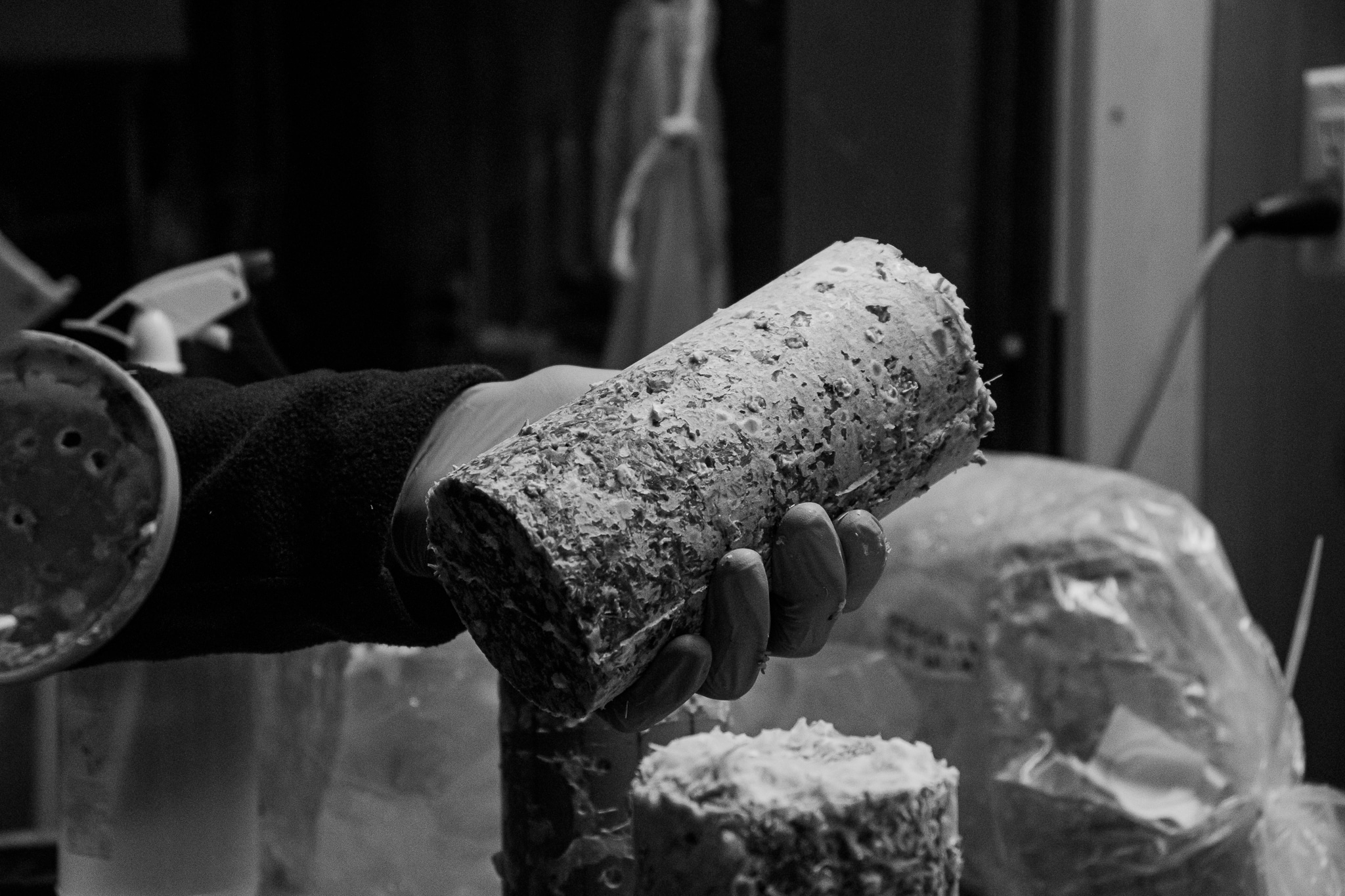
Mercedes Garcia-Holguera and her research teams are trying to develop new construction materials, nature made. To be more precise, they are growing them (source)!
Focus is on two specific biological sources — mycelium, a network of fungal fibers, and bacterial cellulose, a biomaterial synthesized by bacteria. For now, the most promising research is mixing fungi and biowaste to produce insulation pads or bricks that, in some ways, resemble the density and strength of certain insulating materials. Saw dust from local wood shops or straw and hemp from the farmers in the agricultural-based province of Manitoba is mixed with mycelium, the vegetative part of fungi. Over time, the mycelium fungi will eat the biowaste, and the concoctions are then dried and hardened before finally being shaped and put in the oven. Out comes mycelium-made building blocks that researchers hope will be able to change the future of construction.
“Our research could help solve the housing crisis in remote communities of Canada, where the access to building materials is limited and expensive. Tests on growing our material in less controlled environments, outside of the laboratory, are positive and could mean that you can grow bio construction material on site instead of transporting and using more traditional building material as concrete, both leaving a significant carbon footprint”, says Mercedes Garcia-Holguera.
Mercedes Garcia-Holguera is convinced that this operation will work even better in more constant warm or mild climates compared to the Manitoban weather where a very short and very warm summer is replaced by a -10°C to -40°C hard and windy winter.
“Some biomaterials respond positively to changing conditions. Just like nature. This also means that production can be set up in rural areas or suburbs, where local or regional producers of industrial or agricultural byproducts, like farms or wood construction plants, can add a new production line of biomass construction materials”, Garcia-Holguera tells.
The thoughts on developing locally made biomass construction solutions are tested globally by other researchers. In the UK, for instance, a team from the University of East London is testing “Sugarcrete” (source). Ultra-low carbon building components using sugarcane bio-waste, called bagasse. This could soon help local communities in the sugar producing countries, where construction materials often are imported at a high cost and with a heavy carbon footprint, just like in the remote communities of Canada.
WE MUST LEARN FROM NATURE TO SAVE THE ENVIRONMENT
The Canadian BIOM Lab research team is inspired by Biomimetics, the discipline of mimicking living plants and animals in the way in which they solve problems or tackle tasks and then apply them on for instance engineering, chemistry, or biology to try and solve complex human problems.
“Our research still has some way to go before it can be commercialized and mass produced. But it could be one of the ways to address current environmental challenges. Not only does this recycle waste products, but the new materials are biodegradable and less harmful to the environment when degraded. They also require much less energy in production than materials like steel or concrete”, says Mercedes Garcia-Holguera.

Photo: The scalability of biowaste building materials still needs proof of concept. A 3-meter-high structure geodesic dome attached with different panels of biomaterials to test their performance and durability in Winnipeg’s changing weather
And then we are back to the architect and professor’s argument on designing buildings to decay. A statement she acknowledges might strike nervous ticks on any building owner or constructor.
“At this time in our research, we still do not know how long the biomaterial can hold its strength and insulating features. But we cannot expect biomass materials to replace more traditional materials like steel and concrete with a significant carbon footprint without changing our perspective on life expectancy. Shorter life span is not negative if carefully integrated in the design process, and we must stop trying to make nature fit into development and financial growth. It could be the other way around. Biomass will decay but can be replaced and reused as long as the vital structures of a building can last for long”, says Mercedes Garcia-Holguera.
The scalability of biowaste building materials still needs proof of concept. At the University of Manitoba next step is to weather test a 3-meter-high dome and a shelter-like prototype made with biomaterials. If that works, next steps would be to engage in collaborations with industry partners. It might seem a long way before Mercedes Garcia-Holguera and her team can make a real impact. It could take years, but she is confident that this is the right pathway.
“The construction industry might still be skeptical, of course they are. So, we need to get more stakeholders involved, build new alliances, make a lot of trial and errors, and create a whole new industry to produce biomass building materials. Whenever I present our research and product to the broader public people are very interested and in favor of finding new natural ways to address climate change. Now we need the professionals to come on board”, Mercedes Garcia-Holguera explains.
She points to the fact that the research on making products out of biowaste, and mycelium are well tested and has been going on for more than 10 years. Companies like Ecovative, based in Green Island, New York, USA, produce consumer products like food, leather and packaging. So, the technology is there. It is all about scale and will.
Read more about the project here.
Planetary Responsibility Insights are based on interviews with experts, scientists, business leaders and others with the purpose of sharing knowledge and opinions on sustainability and nature-based solutions in the built environment.
ABOUT PRF
PRF is a private, commercial foundation, established in 2022. Our purpose is to help restore and protect the planet’s nature and biodiversity and promote sustainable development. We do this through a holistic mindset, mission-driven investments and projects. A key element of our strategy is about doing business differently and in better balance with nature. Therefore, we invest in and support sustainable solutions and knowledge sharing on how to build and live more sustainably.
Did you find this article interesting?
Follow us on LinkedIn and be updated on new articles.
For more information, please visit www.prf.dk