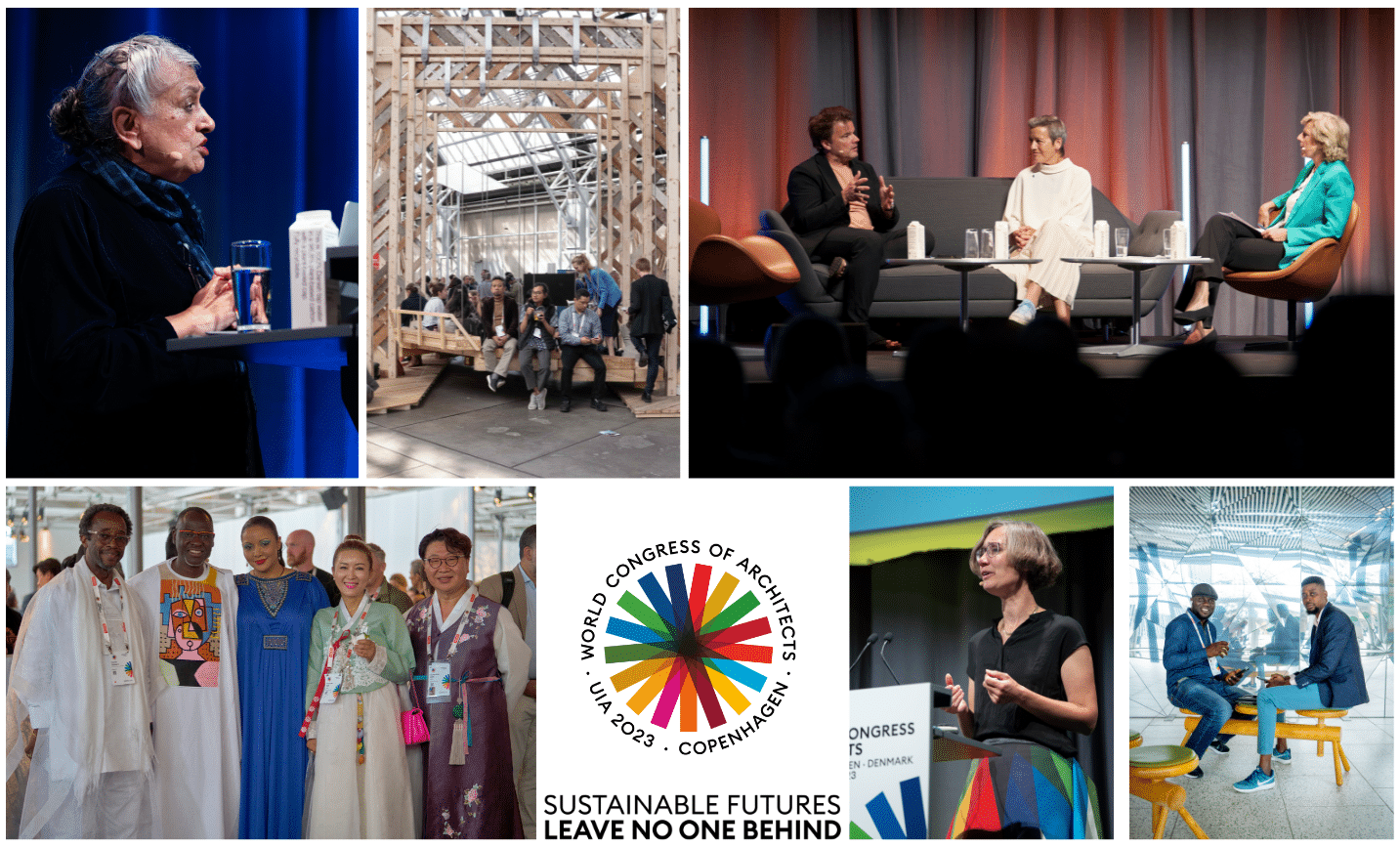
It almost sounds like a commanding team leader’s wrap-up before going on a rescue mission. “Leave no one or nothing behind!”
Fortunately, it is a bit more peaceful, but nonetheless a challenging rescue mission. The challenges involve fighting climate change, increasing biodiversity, and promoting social inclusion. More than 6,000 international architects, and researchers stand guard for the challenge called the ‘Copenhagen Lessons’: 10 principles for rapid and radical change in the built environment. The Copenhagen Lessons were presented at the closure of “Sustainable Futures – Leave No One Behind,” a part of the UIA World Congress of Architects in the summer of 2023, held in Copenhagen, Denmark (source).
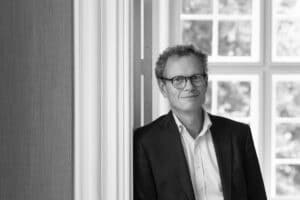
To Mette Lindberg, CEO at the UIA World Congress of Architects 2023, the outcome of the congress is bold and radical.
“Bold in the sense that so many different nations now stand together for a sustainable future in the built environment. Radical in the way that architects all over the world have framed their global principles for the future,” Mette Lindberg explains.
The ‘Copenhagen Lessons’ consist of 10 principles for a rapid and radical change in the built environment to achieve the UN’s 17 Sustainable Development Goals (source).
THE COPENHAGEN LESSONS
- Dignity and agency for all people are fundamental in architecture; there is no beauty in exclusion.
- People at risk of being left behind must be accommodated first when we construct, plan, and develop the built environment.
- Existing built structures must always be reused first.
- No new development must erase green fields.
- Natural ecosystems and food production must be sustained regardless of the built context.
- No virgin mineral material must be used in construction when reuse is possible.
- No waste must be produced or left behind in construction.
- When sourcing materials for construction, local renewable materials come first.
- In everything we build, carbon capture must exceed carbon footprint.
- When developing, planning, and constructing the built environment, every activity must have a positive impact on water ecosystems and clean water supply
“The 10 principles of the ‘Copenhagen Lessons’ are not a global charter. Rather, they serve as a catalog of inspiration we, as contributors to the built environment, must implement in all our endeavors. If architects, politicians, local planning authorities, commercial partners, and everybody else involved in the built environment unite around these principles, we can truly make a difference. Not to forget, the Copenhagen Lessons also fit perfectly for every educational institution within our sector. In that sense, we need to start giving back both to the world and future generations,” says Mette Lindberg.
“The 10 principles of the ‘Copenhagen Lessons’ are not a global charter. Rather, they serve as a catalog of inspiration we, as contributors to the built environment, must implement in all our endeavors.”
UNITED DESPITE BIG DIFFERENCES
Now the words will have to be put into action in their respective markets. Probably no one will work with all 10 lessons at once. In certain countries or regions, working with existing built structures that always must be reused may seem crucial, while in other parts of the world, the lesson on “No waste must be produced or left behind in construction” is a task with top priority.
“We may have significant variations in our approaches to the 10 lessons, and they will have to be adapted to local conditions. However, we are more united than it seems. We are collectively working towards the same goal – the well-being of the planet and fundamental human needs are at stake, and we have no time to waste,” says CEO of the UIA World Congress of Architects 2023, Mette Lindberg.
According to Mette Lindberg, the reception of the ‘Copenhagen Lessons’ in the individual countries has been overwhelmingly good among architects and the built environment sector. Now comes the next step: knowledge sharing and measuring.
“We have made the pledge to implement the lessons in our work and meet up again in three years’ time for evaluation. But already at the beginning of 2024, we hope to have effective monitoring methods to build stats and figures on the architectural solutions for each of the 10 lessons. Once in place, we can share insights not only within our own sector but also with the broader built environment community,” explains Mette Lindberg.
For more information, please visit UIA.
Planetary Responsibility Insights are based on interviews with experts, scientists, business leaders and others with the purpose of sharing knowledge and opinions on sustainability and nature-based solutions in the built environment.
ABOUT PRF
PRF is a private, commercial foundation, established in 2022. Our purpose is to help restore and protect the planet’s nature and biodiversity and promote sustainable development. We do this through a holistic mindset, mission-driven investments and projects. A key element of our strategy is about doing business differently and in better balance with nature. Therefore, we invest in and support sustainable solutions and knowledge sharing on how to build and live more sustainably.
Did you find this article interesting?
Follow us on LinkedIn and be updated on new articles.
For more information, please visit www.prf.dk