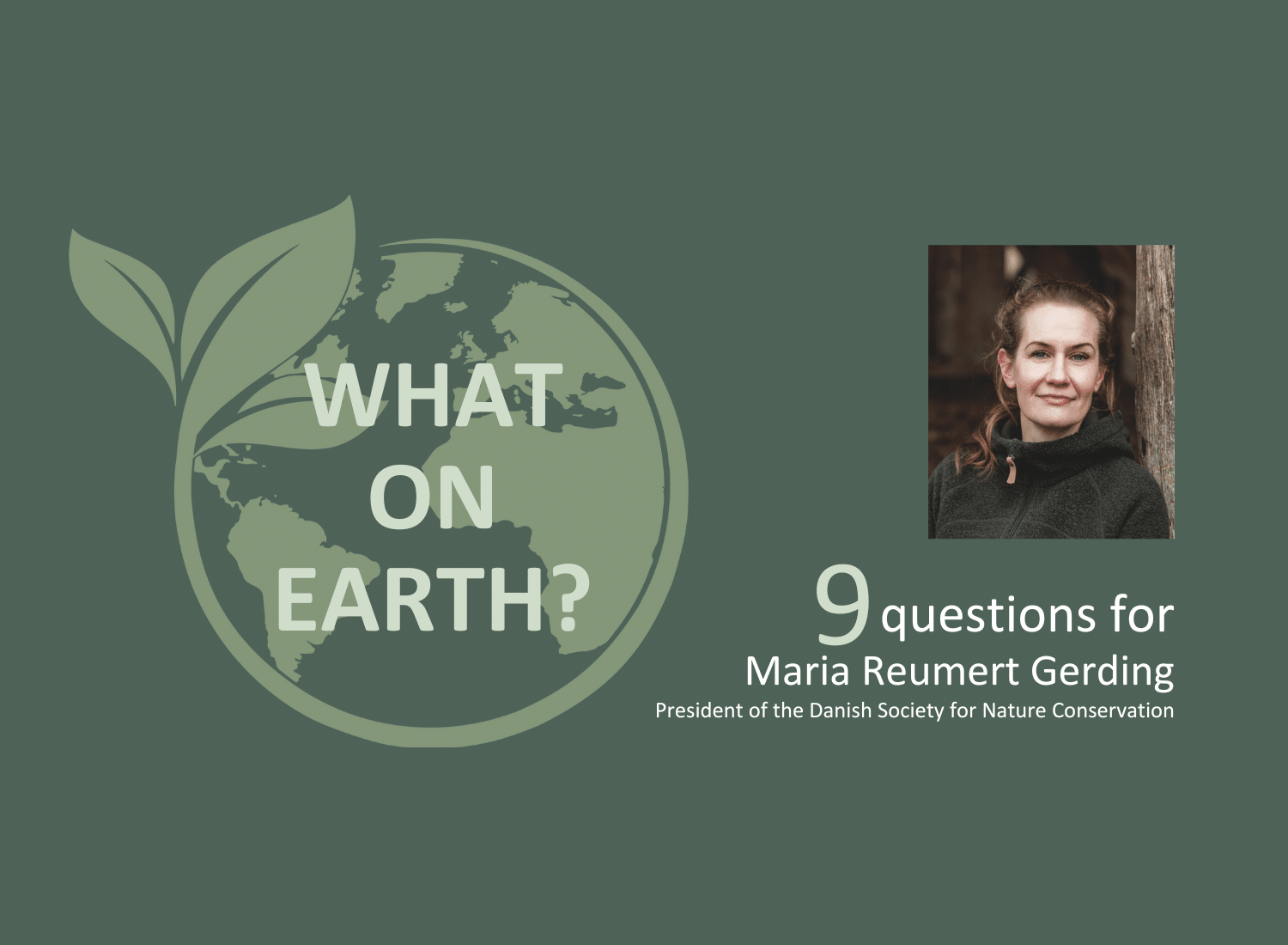
1. WHAT ARE YOUR ORGANIZATION’S SPECIFIC OBJECTIVES AND GOALS?
Overall, our stated objective is to create a sustainable society in Denmark with a beautiful and varied landscape, a rich and diverse nature, a clean and healthy environment and without negative climate impacts and for the general public to have access to nature. The Danish society for Nature Conservation is by far the largest (135,000 members) and oldest (founded in 1911) of all the Danish environmental NGOs. As stated above, our double and equal raison d’etre is to protect nature in the widest sense of the word and at the same time to ensure that the general public has access to nature. Therefore, we have since time immemorial, worked to dissolve all legal and physical barriers that stand in the way of access to, i.e., our coastline. It is unique for Denmark that nearly all of our 7,000 kilometers long coastline is accessible for everyone and not just for the privileged few who happen to own property along the coast.
At the same time, DN is the driving force behind much of the legislative work directed at environmental protection. Whether it be through the laborious work to identify and set in place permanent protection clauses for designated areas of natural beauty, or through the day to day practical work on an individual and local basis of ensuring that farming entities do not swamp their surroundings with either buildings or pollutants. DN is the main author and instigator of much of the legislative work on for instance water protection, pesticide legislation, national parks etc. We are present at the national level with our headquarters in Copenhagen, at the municipal level with local chapters in all the 95 out of the 98 Danish municipalities and at the international level through our membership of the EEB (The European Environmental Bureau). In order for us to be relevant and to shift the political agenda, we strive to be present in local and national media on a daily basis. We have a very high media profile in newspapers, radio, and television, through campaigns and SoMe on all platforms. Sometimes through reacting to the news around us, but also quite often through placing our own stories in the media – i.e. pesticides in drinking water, marine protection, nature conservation, etc. We are universally recognized in the Danish population as the third most recognized organization, only surpassed by the Confederation of Danish Industries and the umbrella organization for all the Danish unions. Our philosophy is that politicians only put their time and political capital behind that which the population is interested in. So, we need to be knowledgeable and at the same time, we need to be known and recognized.
2. WHO DO YOU COLLABORATE WITH IN TERMS OF BUSINESSES, AND HOW DO BOTH PARTIES GAIN FROM IT?
Companies play a crucial role in the green transition and therefore they are relevant for us to collaborate with. For us, these collaborations can support our overall goals by getting more actors involved in creating a sustainable and climate-friendly society with a rich nature and clean environment. We believe that cooperation and dialogue is crucial to achieve such a society, even with actors where we might not agree on certain things or have a different approach to sustainability. As we are regarded as a trustworthy organization, we experience an interest from companies in collaborating with us. Our collaboration with businesses looks different depending on the individual company. It can involve development of more environmentally friendly production methods or more sustainable products, support in defining and reaching their green CSR-goals, sparring on concrete environmental and climate areas or general running updates with relevant news and developments on relevant areas.
Besides the inherent advantages of a more sustainable production, businesses can gain from collaborations with us through a stronger network, clearer and more achievable CSR-goals and by creating a more responsible and green brand.
We tend to work more at an industry level rather than with individual companies but do have some collaborations with individual companies. Among others, these include collaborations with the supermarket chain Rema 1000 on biodiversity and the electric car manufacturer NIO on nature protection, easier access to nature and reducing waste.
3. WHAT WORKS WELL - AND LESS WELL – IN THE COLLABORATION WITH BUSINESSES?
As mentioned, we tend to work more at the industry level than with individual companies. Our objectives are to create an interest in the broader environmental issues. We have established strategic partnerships with The Danish Agriculture and Food Council, The Danish Fishers, and several of the solar and wind companies.
Specifically, we have made agreements with The Danish Agriculture and Food Council Farmers about turning 100,000 hectares of bogland back to nature and with The Danish Fishers to protect 10 percent of the Danish marine environment. As such these partnerships are quite successful and have helped push Danish nature and environment in the right direction.
It is still rather frustrating however that the green issues at large are still seen as icing on the cake rather than something necessary for them. They are only involved as long as the green initiatives either create a profit or at least do not constitute a cost.
As soon as there is the slightest risk that nature protection gets in the way of their profit, they start dithering. We want to transform this way of thinking in order for nature to be taken into account at the same level as safety in the workplace – something that naturally gets considered at all levels of the business community.
4. WHAT WOULD BE ONE ADVICE FOR THE COMPANIES THAT IMPACT YOUR WORK?
Overall: Be honest in your intentions and be transparent in your processes. Concretely: Take biodiversity just as seriously as climate considerations. This will become an essential commodity within a few years. And specifically, that we can’t solve one crisis at the cost of another.

5. IF YOU COULD WISH FOR ONE SPECIFIC PRIVATE PARTNERSHIP – A COLLABORATION, PROJECT, OR SOMETHING ELSE, WHAT WOULD IT BE?
Everybody wants to be friends with green tech, whether it be solar, wind, electric vehicles etc. We do too! This gives green tech a particularly high responsibility to take other things than climate into consideration. The coming years will see huge investments here and we cannot allow for biodiversity to go down the drain because of the appetite for renewables. We fully support the transition to renewable energy, but as already mentioned, we can’t solve the climate crisis by exacerbating the biodiversity crisis.
6. WHICH AND WHAT KIND OF RELATIONSHIPS DO YOU HAVE WITH NATIONAL AND INTERNATIONAL AUTHORITIES?
We have entered a strategic partnership with European Energy offsetting areas of solar parks and windmills with areas for biodiversity – more specifically for every 100 hectares of solar panels, five hectares of vulnerable biodiversity will be purchased, likewise for every windmill, one hectare will be bought.
7. WHAT WORKS WELL - AND LESS WELL – IN THE COLLABORATION WITH AUTHORITIES?
DN is taken very seriously as a partner for the authorities, whether these be ministries or local municipalities. We are involved in most legislative processes regarding environmental issues. What still does not work very well is that changing governments have put a wedge down between climate and biodiversity considerations. There is a very stubborn public narrative that claims for there to be opposite interests between initiatives to solve the climate crisis and initiatives to alleviate the biodiversity crisis. This is only true, if we let it be true. The two crises are interlinked and we have to find solutions which – if not solving both at the same time – then at least don’t aggravate/amplify each other.
8. WHAT WOULD BE ONE ADVICE FOR AUTHORITIES THAT IMPACT YOUR WORK?
One crisis cannot and must not be solved at the cost of the other. We cannot allow for areas of outstanding beauty, biodiversity and natural interest to be ruined in order to solve the climate crisis.
9. IF YOU COULD WISH FOR ONE SPECIFIC NATIONAL OR INTERNATIONAL LEGISLATIVE CHANGE, WHAT WOULD IT BE?
Definite and specific legislative measures and to protect and recreate nature. Legislative recognition of the potential of nature to act as a means to solve the climate crisis – woodland, permanent pasture etc.

ABOUT PRF
PRF is a private, commercial foundation, established in 2022. Our purpose is to help restore and protect the planet’s nature and biodiversity and promote sustainable development. We do this through a holistic mindset, mission-driven investments and projects. A key element of our strategy is about doing business differently and in better balance with nature. Therefore, we invest in and support sustainable solutions and knowledge sharing on how to build and live more sustainably.
Did you find this article interesting?
Follow us on LinkedIn and be updated on new articles.
For more information, please visit www.prf.dk