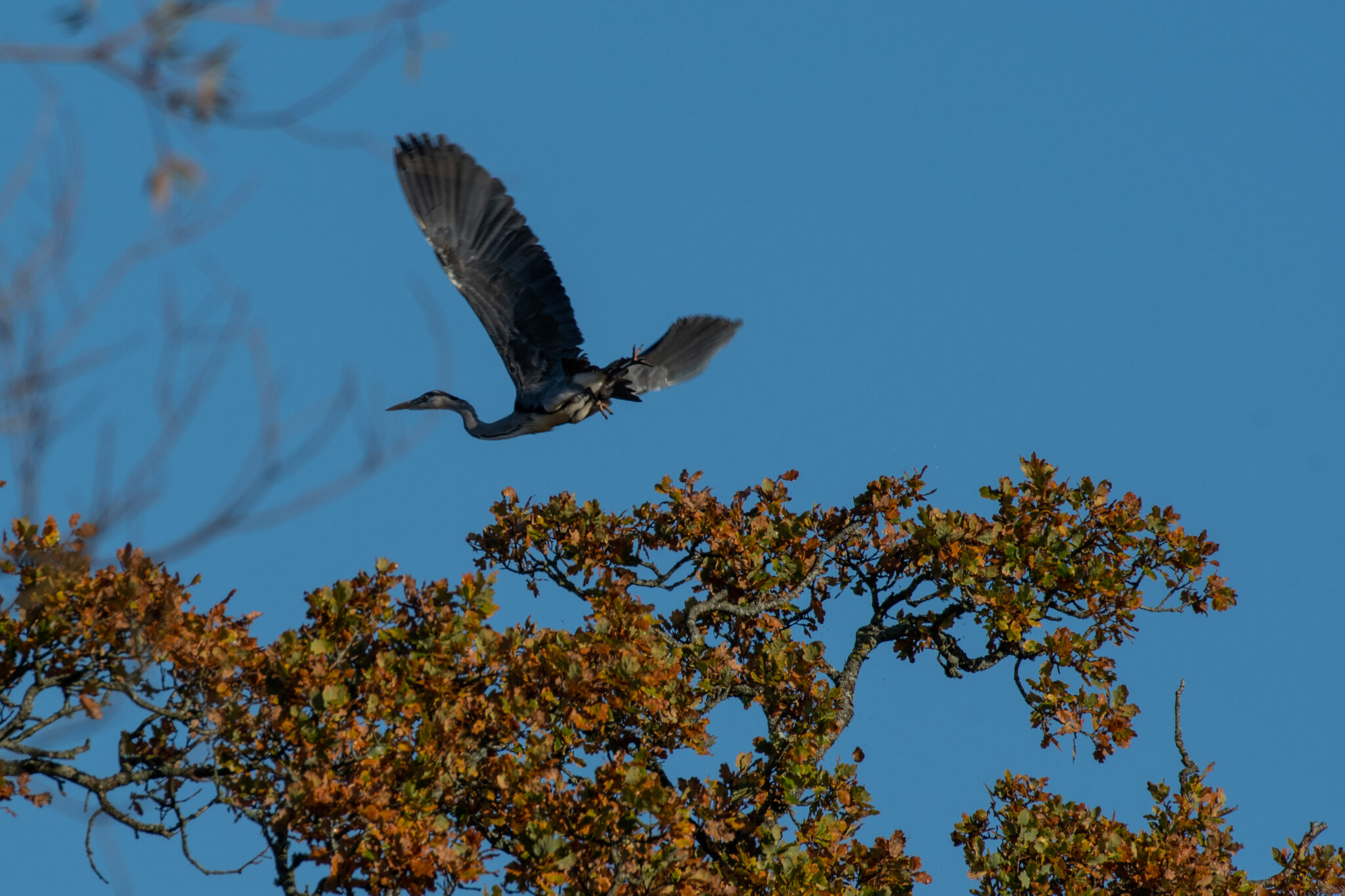
Photo credit: © Charlie Burrell / Knepp
“Restoring the Planet” is a global series of articles where PRF interview and engages the people leading large-scale nature restoration projects around the world — from wetlands and forests to grasslands and marine habitats. The aim is to share insights, inspire others, and highlight how real progress is made for biodiversity and ecosystem recovery at scale.
In this article we look at Knepp Estate in West Sussex, United Kingdom
A white-tailed eagle cuts across the sky above Knepp Estate in West Sussex.
Below, a group of farmers stands watching the floodplain. Land that, not long ago, was intensively farmed and largely silent.
Then movement.
White storks rise and give chase, their wings catching the light as they circle the eagle and push it onward across the horizon.
The moment lasts only seconds.
But it captures something that would have seemed impossible a decade earlier.
“I took a group of local farmers out about a month ago to look at the beavers. They’ve all escaped now from the licensed enclosure and are reshaping the floodplain. And while we were standing there, a white-tailed eagle flew overhead, being chased by five storks. If you had asked me ten years ago whether I would ever see something like that in southern England, I would have said it was impossible. What we are seeing now is beyond what we thought we would achieve. It’s not just recovery; it’s something entirely different emerging.”
Scenes like this have become emblematic of Knepp Estate https://knepp.co.uk/. Not because they were planned. But because they were not.
For much of the twentieth century, Knepp followed the logic of low-margin English farming on difficult land. The soils were heavy Weald clay. The operating model depended on effort, machinery and subsidy all pulling in the same direction. Fields had to be pushed harder than they wanted to be pushed, and every year the land reminded its owners that productivity and suitability are not the same thing.
Knepp’s eventual transformation into one of Europe’s best known rewilding projects was therefore not born from romance. It came from a confrontation with agronomic and financial reality. The estate had reached the point where staying the course looked less responsible than changing it.
The moment everything changed
The estate’s heavy clay soils had long made farming difficult. Inputs increased, yields stagnated and margins shrank. Subsidies masked the imbalance, but they could not resolve it. Over time, the system revealed its limits.
Burrell still describes the turning point in practical rather than ideological terms.
“My father said, if you’re going to continue living at Knepp, you’ve got to stop farming. He’d gone out to Australia and was ranching there, and his thinking was very simple. Just stop losing money. He wasn’t thinking about nature or rewilding at all. It was purely practical. But that was the moment where everything shifted, because once you stop farming like that, you open up the possibility for something completely different to happen.”
That sentence is important because it clarifies something people often get wrong about Knepp. The project did not start as a manifesto. It began as an answer to a failing business model. The radical ecological consequences came later.
Burrell’s inheritance was therefore not simply an estate, it was a landholding shaped by family history, agricultural convention and the assumptions of an era. The 10th baronet comes from a large Sussex landowning family, one in which relatives understood both the responsibilities and the constraints that came with land. It meant the decision to stop conventional farming did not have to be defended against people who believed agriculture was always an unquestionable end. The challenge lay elsewhere. Persuading institutions that stepping back could count as intelligent land management rather than neglect.

Photo credit: © Charlie Burrell / Knepp
Rewilding without a blueprint
At the time, the word “rewilding” had barely entered mainstream land-use language in Britain. There was no widely accepted domestic template for what Knepp was attempting. That absence of a blueprint created room for an unusually open-ended process.
One of Burrell’s earliest moves was to build a circle of expert support around the estate: academics, field naturalists and specialists with very different interests and methods. Their role was partly scientific and partly political. They helped define what good observation looked like when the goal was not to impose a finished design on the land, but to let ecological processes take.
“One of the first things I did was to bring together an advisory group – people from different disciplines, birders, botanists, people interested in beetles, lichens. It was quite an eclectic mix, mostly academics. But they were absolutely critical, because they were not only helping shape what we were doing, they were also the people who would defend it. When you have a new minister come in and say ‘this rewilding nonsense has got to stop’, you need people who can stand up and argue for it. These projects are risky for government, and you need that backbone behind you.”
That passage helps explain why Knepp matters beyond ecology. The project always had an institutional dimension. New land models do not survive on evidence alone; they also need constituencies, translators and people able to defend uncertainty in public. Rewilding, especially in its early years, asked policymakers to tolerate outcomes that were not tightly scripted. That can feel unsettling inside systems trained to reward predictability.
The advisory group did more than lend credibility. It created a shared language through which Burrell could discuss what was happening at Knepp not as eccentric estate management, but as an experiment with implications for agriculture, subsidy design and conservation policy.

Photo credit: © Charlie Burrell / Knepp
Letting nature take the lead
What emerged at Knepp was not restoration in the classic sense. There was no attempt to recreate a historically fixed habitat map. No target list of species was used as the single measure of success. Instead, the estate moved toward process-led regeneration.
Free-roaming grazing animals became central to that shift. Cattle, pigs, deer and ponies functioned not as tightly managed units of production but as ecological actors. Through grazing, browsing, rooting and trampling, they introduced disturbance and variety: scrub thick in one area, open ground in another, young woodland elsewhere, wetland forming where water was finally allowed to behave like water.
It demonstrates that “doing less” is not the same as abandonment. It is, rather, a transfer of agency back to ecological processes. The practical management challenge becomes one of setting broad conditions, observing feedback and resisting the urge to tidy away complexity.
The return of ecological function
Once structural diversity began to increase, the estate changed quickly. Not because someone planted biodiversity into the ground, but because the conditions that support biodiversity became available again.
Insects multiplied. Bird populations rose. Wet areas developed their own logic. Seasonal flux became visible rather than suppressed. What Burrell emphasizes is not merely the return of particular charismatic species, but the recovery of relationships between species. A functioning landscape is not an inventory. It is a set of interacting processes.
That distinction matters because Knepp is often described through spectacular sightings. The eagle and the storks make a dramatic opening image, but they are not the whole story. They are surface evidence of deeper systemic change.
“We’ve now got the highest density of breeding songbirds in Britain, which is quite extraordinary when you think about where we started. And during migration, we have hundreds of thousands of birds coming through Knepp to feed on their way down to Africa. That tells you that the system is functioning again – it’s not just about individual species, it’s about the whole web of life starting to work.”
Burrell’s wording explains why Knepp has resonated so widely with scientists, landowners and the public. The project offers visible proof that degraded farmland can become a living system again without requiring a fully engineered ecological script.

An estate with a family history
Knepp is often discussed as a breakthrough project, but it is equally a story about continuity and inheritance. Burrell did not arrive as an outsider with a fresh site. He was working inside a multi-generational estate with established expectations, buildings, tenancies, land patterns and social obligations.
His wider family knew land. They understood farming realities. What he inherited, then, was not only acreage but also the burden of deciding what kind of steward he wanted to be in a period when old agricultural assumptions were no longer convincing.
That historical dimension matters because rewilding can be misread as rupture. At Knepp it is better understood as a difficult evolution of stewardship: away from the duty to maximize conventional output from every acre, and toward the duty to make the estate ecologically and economically coherent for the long term.
A different kind of economy
The ecological transformation at Knepp would not have lasted if the business had remained structurally weak. This is where the estate’s story becomes especially significant for other landowners.
Before rewilding, conventional farming on the estate was loss-making once subsidies were removed. The old model consumed labour, buildings, machinery and managerial energy while generating inadequate returns. After the transition, the estate did not replace that model with one single “nature business”. It built a portfolio.
Farm buildings that once held grain or cattle were converted into workspaces and units for local businesses. Housing requirements changed because the estate no longer needed the same kind of resident agricultural staff structure. Tourism grew. Hospitality followed. Meat from free-roaming animals found direct markets. A farm shop, food offering and visitor economy grew around the simple fact that people wanted not only to hear about Knepp, but to come and see it for themselves.
“If you strip away the subsidies, the farming business had been loss-making for decades. It was effectively being propped up by taxpayers’ money on very poor agricultural land. What we’ve done is transform that by creating multiple income streams converting buildings into business units, developing tourism, selling directly to customers. We’ve now got around 200 people employed in those buildings, and the estate has become economically viable in a completely different way.”
Burrel does not argue that other estates must imitate Knepp’s exact mix of glamping, safaris, meat sales and business rentals. Just pointing to the fact that restored nature can underpin diversified economics. The unit of analysis changes away from one land use and toward a whole landscape economy.
For Knepp Estate the tourism offer is not incidental, it has become central. The estate now runs safaris for thousands of visitors each year. The wider tourism and hospitality business turns over millions. There is a market garden. There is regenerative beef. There is venison and pork from the rewilding system. And crucially, much of this value is captured directly, rather than leaking away through long supply chains.
Photo credit: © Charlie Burrell / Knepp

Benchmarking the shift
The estate’s economic claims are not made in the abstract. Burrell points to benchmarked comparisons with mainstream agricultural performance to show that Knepp is no longer just emotionally satisfying or ecologically admired. It is commercially credible.
Savills https://www.savills.com/ — the international real estate and land advisory firm widely used as a benchmark across UK agriculture — compared Knepp’s gross margin performance with conventional farm categories. The comparison matters because it places Knepp inside a language that landowners, lenders and advisors recognize.
“We did a comparison with Savills looking at our figures against conventional farms. In 2020, we were making around £1,173 per hectare, compared to about £666 for a good arable farm and £543 for a mixed organic farm. And that’s on land that was previously unprofitable. So, it’s been a complete shift. Not just ecologically, but economically as well.”
Burrells tells this to cut through one of the most persistent objections to rewilding. That it is economically indulgent. Knepp suggests something more complicated and more challenging. Under the right conditions, land once treated as agriculturally weak can outperform more conventional comparators if value is reassembled differently.
Public support, grants and the politics of transition
Knepp’s story is sometimes presented as though it succeeded entirely through private daring. Burrell is more candid than that. Public support mattered, and in one important case in early years, government turned out to be more flexible than expected.
“We were fortunate in that a key government department supported us without imposing overly prescriptive targets. That gave us the space to let the system evolve, even when the outcomes were uncertain. One of the real challenges for policy is how you support something dynamic like this without forcing it back into a fixed framework.”
There are also direct public funds associated with innovation. Burrell describes a major grant connected to the estate’s investment in an advanced CO2-based refrigeration system, part of the infrastructure that has made year-round processing and storage of meat possible while sharply reducing energy use.
Scaling beyond Knepp
The estate itself is now relatively mature as a model. The larger frontier, for Burrell, is replication.
That is where the conversation shifts from Knepp as place to Knepp as platform. Through NatCap https://natcapresearch.com/, he is working on structures that can monetize verified uplift in carbon and biodiversity. The objective is not simply to sell offsets, but to create a financing architecture through which land can be secured for nature over time while still generating returns.
This is a crucial evolution because it addresses the most persistent bottleneck in large-scale restoration, capital. Land purchase is expensive. Restoration takes time. Investors need structures they can understand. If ecological uplift can be measured and sold into emerging markets, projects no longer have to rely exclusively on grants, philanthropy or charismatic founders.
“What’s really interesting now is that we can demonstrate both carbon and biodiversity uplift. Through NatCap, we’re beginning to sell carbon and biodiversity credits and work with developers. If we can scale that model and attract investment, then you suddenly have something that isn’t dependent on grants. You have a system that can pay for land over time and deliver returns, while the land itself is secured for nature in perpetuity.”

Photo credit: © Charlie Burrell / Knepp
What comes next
Knepp’s influence on the wider rewilding movement is now difficult to overstate. Burrell has served in leadership roles in Rewilding Britain and on the board of Rewilding Europe. He saw early on that if Knepp could produce evidence rather than theory, it might help shift the terms of public debate.
That wager appears to have paid off. Rewilding is no longer a fringe idea in Britain Knepp has helped create that shift by functioning as proof of concept.
“If you can combine restoration, investment and public engagement, then you can start to do this at scale.”
There are tweaks and expansions under consideration, some ecological, some financial, some institutional. Burrell mentions bison as a species he would love to have. More significantly, he is focused on innovation around investment structures, returns and scaling. The strategic horizon has broadened from one estate in West Sussex to the question of how restored land can become an investable category in Britain and beyond.
“For Knepp itself, it’s not about radical change anymore. It’s about innovation – small shifts, new ideas, refining what we’ve built. But the bigger opportunity is taking this model elsewhere. And that’s where it becomes really interesting.”
The estate’s greatest significance may not lie in what it has already become, but in what it has made imaginable for others.
The estate suggests that, under some conditions, control can become the thing that suppresses both ecological and economic value. By loosening its grip, Knepp has not retreat from the land. It has entered a different relationship with it. When conventional systems are failing, nature recovery need not be a luxury. It can be a serious answer.
And when a white-tailed eagle crosses the sky above a floodplain remade by beavers and chased by storks, the answer becomes visible.

Photo credit: © Charlie Burrell / Knepp
Fact box: Sir Charles Burrell
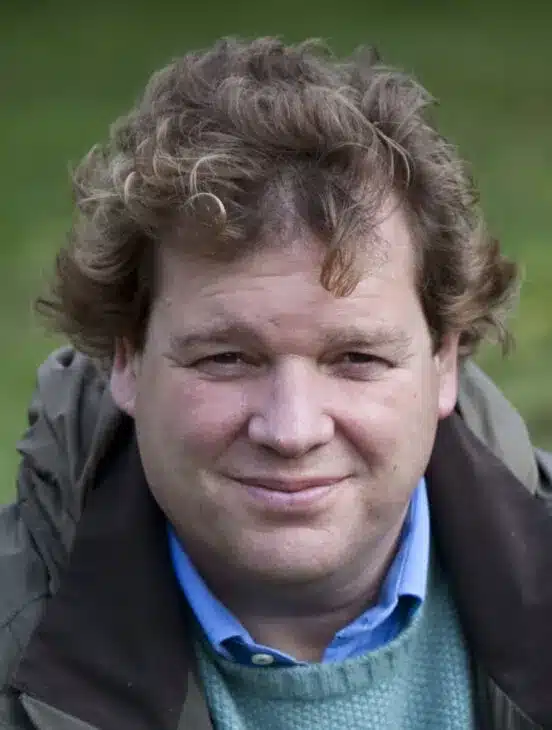
Sir Charles Burrell is a British landowner and one of the most prominent pioneers of rewilding in the UK.
He manages Knepp Estate in West Sussex, land that has been in his family for generations and forms part of a wider Sussex landowning lineage.
When Burrell took over the estate, he inherited a conventional farming operation built on heavy clay soils and dependent on subsidies to remain viable. In the early 2000s, he led the transition away from intensive agriculture and toward large-scale rewilding, allowing ecological processes to drive regeneration across the estate.
Under his leadership, Knepp has become one of Europe’s most influential restoration projects and an important proof of concept for nature-led land management, diversified rural enterprise and the emerging markets for carbon and biodiversity uplift.
Burrell has also played a wider role in shaping the rewilding movement through his involvement in Rewilding Britain and Rewilding Europe. Today, his work increasingly focuses on scaling the Knepp model through new financial and institutional structures that can secure land for nature over the long term.