Along the Araguaia River in Brazil, a green spine is slowly re-emerging across a landscape once fractured by deforestation.
Stretching more than 2,600 kilometres and up to 40 kilometres wide, the Araguaia Biodiversity Corridor https://www.black-jaguar.org/the-araguaia-corridor/ is designed to reconnect fragments of rainforest and savanna across six Brazilian states. When completed, it will form the longest biodiversity corridor on Earth.
The geography alone is difficult to comprehend. The corridor crosses more than 112 municipalities and touches close to 13,000 rural properties, mostly privately owned. It is not a fenced reserve carved out from economic activity. It is a working landscape: cattle ranches, soy fields, smallholdings, river systems and forest fragments, woven together through restoration.
Behind the initiative stands Ben Valks, founder of the Black Jaguar Foundation. https://www.black-jaguar.org/
“Our mission is very clear,” Valks says. “We plant native trees on a massive scale to help realize the Araguaia Biodiversity Corridor to restore the balance between nature and humankind.”
The ambition is immense: one million hectares restored. 1.7 billion native trees planted over the next 20 years. But scale alone does not define the project, as Ben Valks explains,
“What makes the Araguaia Corridor unique is not just its size, but its structure. The Black Jaguar Foundation does not purchase land. It does not create a protected park separated from people. Instead, we operate inside the existing legal and agricultural system using the law as leverage for regeneration.”
Yet the foundation is not buying land or fencing nature. It is working within Brazil’s legal framework transforming legislation into living forest. The bet is bold: if restoration can become a practical pathway for landowners to comply with environmental law, improve soil resilience and secure long-term productivity, then nature can return without displacing economic activity.
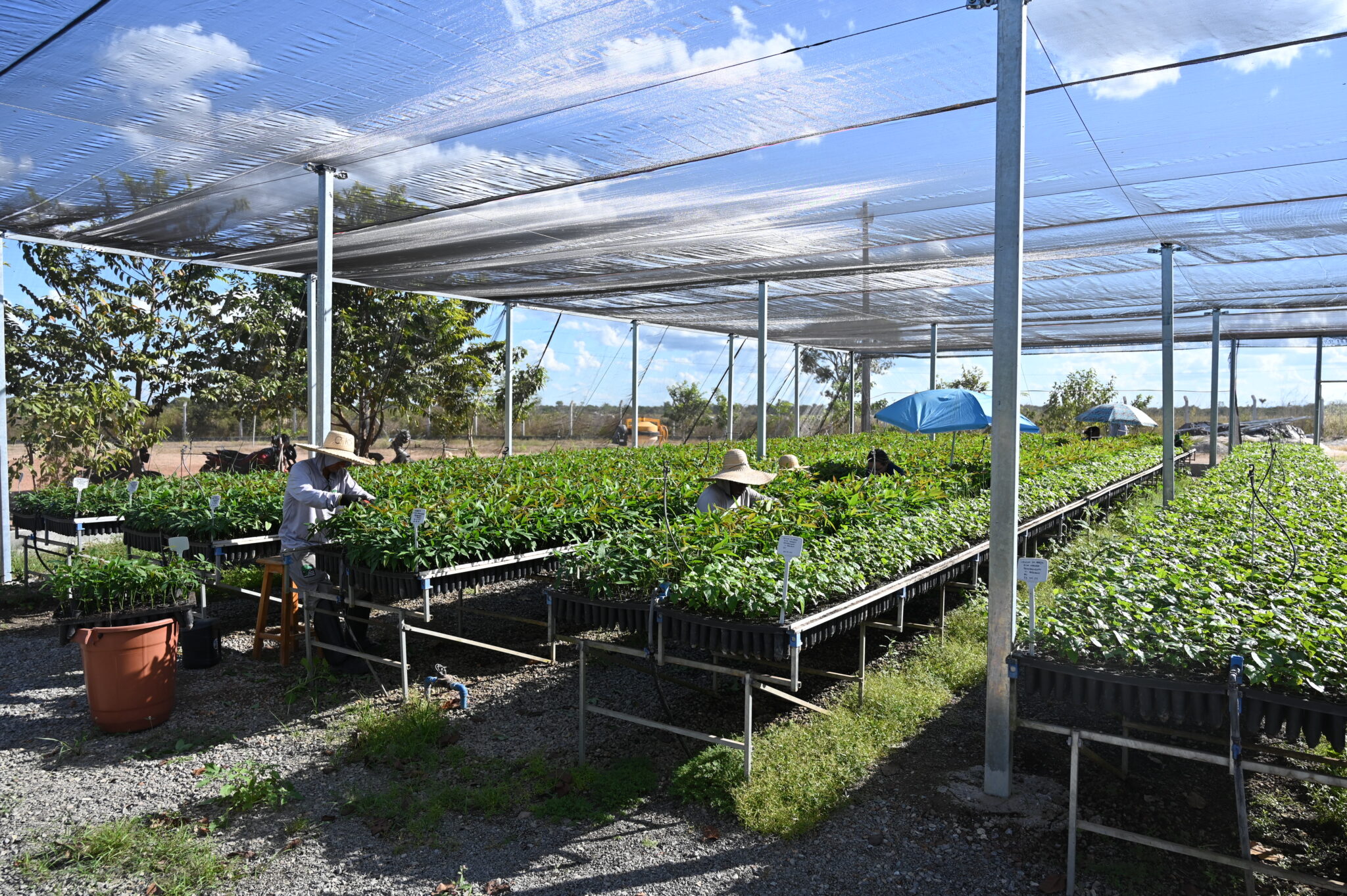
Nursery – people working
Turning legislation into landscape
At the core of the corridor lies Brazil’s Forest Code, widely regarded as one of the strongest environmental laws in the world.
https://cnabrasil.org.br/storage/arquivos/pdf/codigo-florestal-en-resumo.pdf
“The Araguaia Biodiversity Corridor is built on the Brazilian Forest Code,” Valks explains. “The law requires rural landowners to preserve and restore between 20 and 80 percent of native vegetation on private land, depending on biome.”
On paper, that percentage represents one of the most ambitious environmental requirements globally. In practice, it represents a massive technical and financial challenge. Many landowners lack access to ecological expertise, restoration planning, seed supply chains and upfront capital. Compliance therefore becomes complex and often delayed.
“Landowners need technical, legal and financial support to comply,” Valks says. “That’s where we come in.”
The Black Jaguar Foundation positions itself precisely in that gap. Rather than confronting agricultural producers, the organisation approaches them as collaborators in a shared landscape transition.
“We understand farmers as partners. We develop agreements to reforest parts of their land, so they become compliant. Once restored, those areas must remain intact by law.” Each property is mapped scientifically. Forest engineers detect environmental liabilities and design biodiversity plans tailored to soil conditions and ecological context. The process begins with detailed spatial analysis. Satellite imagery and on-site ecological surveys identify permanent preservation areas along rivers and degraded legal reserves that must be restored under the Forest Code. Species composition is then selected according to native biome characteristics. Cerrado species in savanna zones, rainforest species in Amazon areas.
“We reconnect natural habitat islands across farms. That’s how you create continuity at landscape scale.”
The corridor is therefore not a single continuous planting effort, but a strategic reconnection of fragmented ecosystems linking riverbanks, forest remnants and savanna patches into a functioning network.
Two ecosystems, one climate engine
At first glance, the Amazon rainforest in the north and the Cerrado savanna down south appear fundamentally different.
“Fifty-two percent of the corridor lies in the Amazon and forty-eight percent in the Cerrado. One is dense, humid and globally iconic. The other is open, seasonally dry and far less known outside Brazil.,” Valks notes.
Understanding their relationship is key to understanding the urgency of the project.
The Cerrado functions as Brazil’s water tower. Its deep-rooted vegetation stores and releases groundwater, feeding river systems that sustain agriculture, cities and the Amazon itself.
The Amazon, in turn, acts as a biotic pump recycling moisture through evapotranspiration and generating rainfall across South America.
Together, the two biomes regulate continental water cycles. The Cerrado captures and filters rainfall into aquifers and rivers. The Amazon redistributes that moisture through atmospheric circulation. When one system weakens, the other destabilizes.
“Without forests, no rain. Without rain, no agriculture,” Valks says.
The implications extend far beyond Brazil’s borders. Tropical forests now cover roughly 12 percent of the Earth’s land surface, yet they contain about half of terrestrial biodiversity. They are essential carbon sinks and influence approximately 30 percent of global freshwater cycles in the Amazons.
“This is not only a Brazilian issue. It’s about global food systems and climate stability.”
Brazil is one of the world’s largest exporters of soy and beef. European countries are among the largest importers. The hydrological stability of the Amazon and Cerrado therefore underpins global supply chains. Restoration becomes not just ecological repair, but economic risk management.
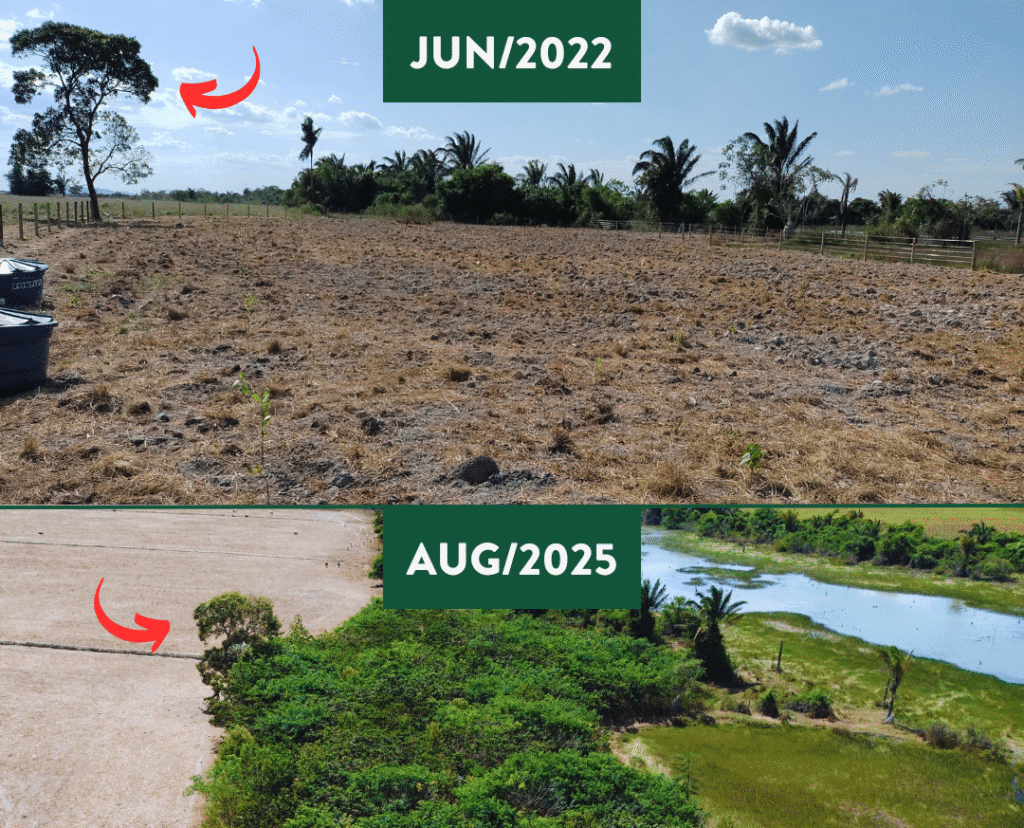
Before/After planting 2 years
Engineering restoration
The Black Jaguar Foundation was founded in 2009, but field operations only began years later. The first decade was spent building networks, studying ecological dynamics and designing what would eventually become a scalable ecological restoration model.
“It took us ten years to develop a robust plan. Today we use 80+ native trees species, which is extraordinary and a concrete sign that our first, second and third objective is quality restoration to bring back biodiversity” Valks says.
Working with Brazilian scientists and forest engineers, the foundation built a 17-step restoration cycle refined through six years of field operations.
“Planting trees is just one step. We begin with community engagement, seed collection, soil analysis and biodiversity planning. Then planting, fire prevention, maintenance and long-term monitoring,” Valks explains.
Each phase is structured. Seed collection networks secure native genetic material. Soil conditions are analysed to determine nutrient requirements and erosion risk. Fire prevention strategies are integrated from the outset particularly critical in savanna regions.
“We adapt to each landscape. Science guides every intervention,” Valks says.
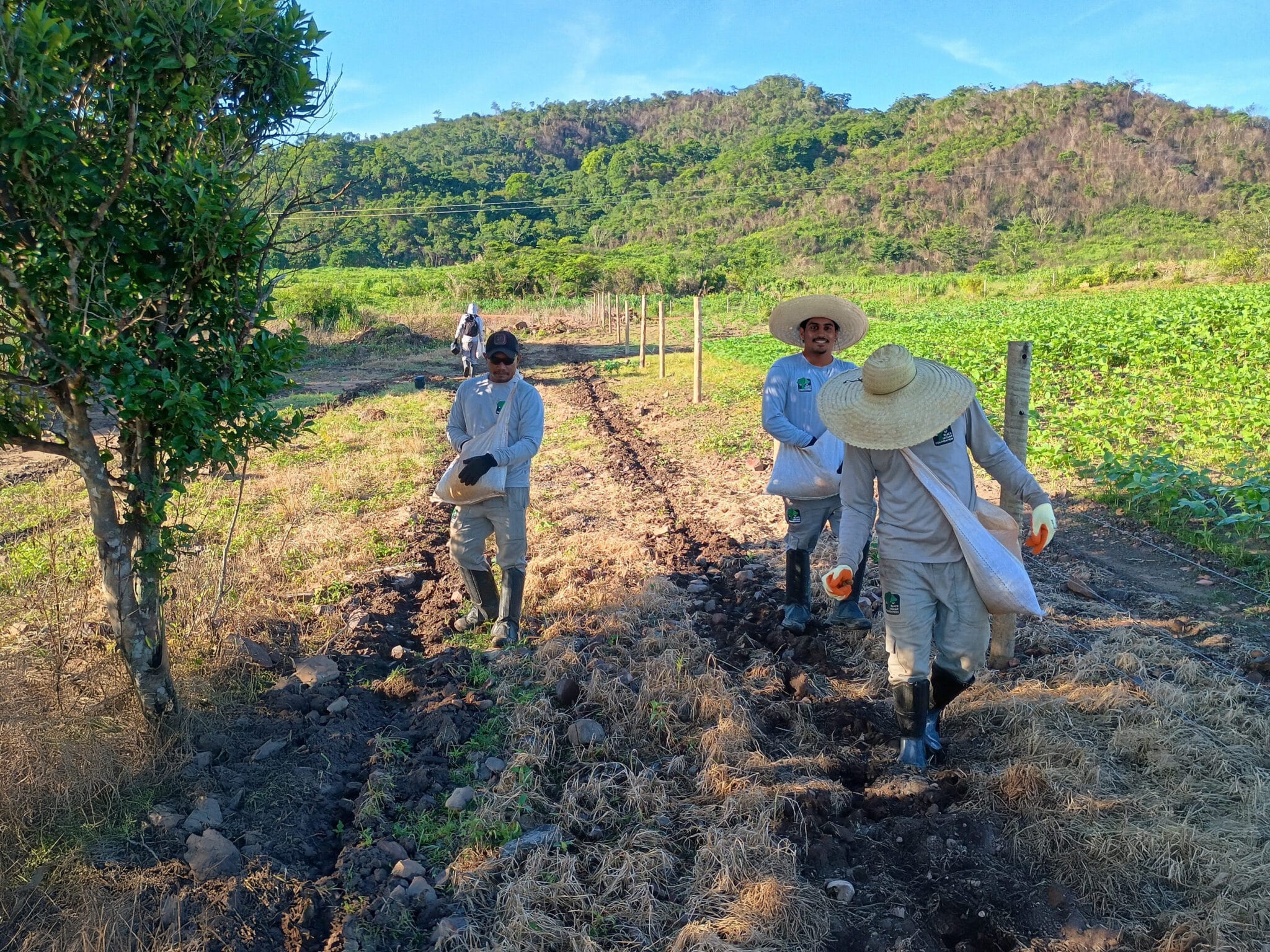
Depending on degradation levels, different restoration methods are applied: Direct seeding, densification, enrichment planting and assisted natural regeneration. In some areas, nature is already attempting to recover. In others, the soil must first be stabilised before planting can succeed. The direct seeding is done using the “Muvuca technique.” A large-scale ecological restoration technique developed in Brazil, where a diverse mix of native seeds is sown directly into degraded land. Instead of planting individual seedlings, the method mimics natural forest regeneration by spreading hundreds of species at once.
Muvuca, inspired by indigenous knowledge, is cost-effective, promotes high biodiversity, and has been widely used in the restoration of the Amazon and Cerrado biomes.
“Timing is critical. Everything must be prepared before the rains arrive,” Valks explains.
Planting is limited to Brazil’s rainy season, typically from September to April. This seasonal constraint imposes logistical precision: nurseries must produce seedlings on schedule, labour must be contracted in advance, and funding must be secured before implementation begins.
From degraded land to restoration economy
The foundations first operational hub is Santana do Araguaia (Pará).
“We started in this region with significant capacity gaps. The area offered little existing restoration infrastructure. But rather than viewing this as a barrier we treated it as an opportunity to build a new local economy around restoration.” Valks recalls.
Today things have changed and the transformation is measurable: 24 landowners across seven municipalities, 620 hectares restored, over 200 direct and indirect jobs created, and 115 active seed collectors, more than 70 percent women.
The Araguaia Seed Network has become a cornerstone of this shift. It includes smallholder farmers, riverine communities and a Kayapó Indigenous group. Seed collectors gather native species across the region, creating income streams where few existed previously.
“The Araguaia Seed Network is decentralized and co-managed by the collectors themselves.”
By decentralizing governance, the foundation reduces dependency and strengthens local ownership. Restoration becomes embedded in livelihoods. Instead of extracting value from land, communities begin regenerating it.
“Seed collectors increasingly recognise the value of biodiversity not just ecologically, but economically. They recognize both the ecological and economic value,” Valks explaines and at the same time underlining that:
” Landowners at the forefront of our ecological restoration efforts. This is the core of our mission: building trust with farmers to restore balance between humankind and nature. This collaborative spirit is essential for the long-term success of our work in the Araguaia region. By collaborating with farmers, local communities, and partners throughout the agricultural sector, we are showing that large-scale ecological restoration can be achieved.
Financing patience
Restoring one million hectares requires sustained capital. Since 2020, the foundation has raised over €2 million annually, significantly increasing capacity in 2024 through partnerships with Rabobank and the UBS Optimus Foundation.
“We finance the entire restoration process. Therefore, our fundraising strategy must be diverse and resilient,” Valks explains.
Funding sources include corporate partnerships, grants, private donations and consumer campaigns such as “Donate a Tree,” where individuals contribute €8 per tree.
Looking forward to 2030, the foundation is exploring innovative and impact investment mechanisms to scale beyond philanthropy by testing diverse restoration models, including agroforestry and silvopasture, and financing mechanisms such as payments for ecosystem services (PES), carbon and biodiversity credits, and concessional finance.
“We must secure funding well in advance to guarantee smooth execution. We aim to transforms restoration from a regulatory obligation into a viable economic sector that links ecological restoration with local economic development.” Valks explains.
Because planting seasons are fixed, cash flow planning is essential. Seedlings must be grown months before planting. Labour contracts must be secured. Delays in funding can delay entire restoration cycles.
“We are developing restoration as a viable business case.”
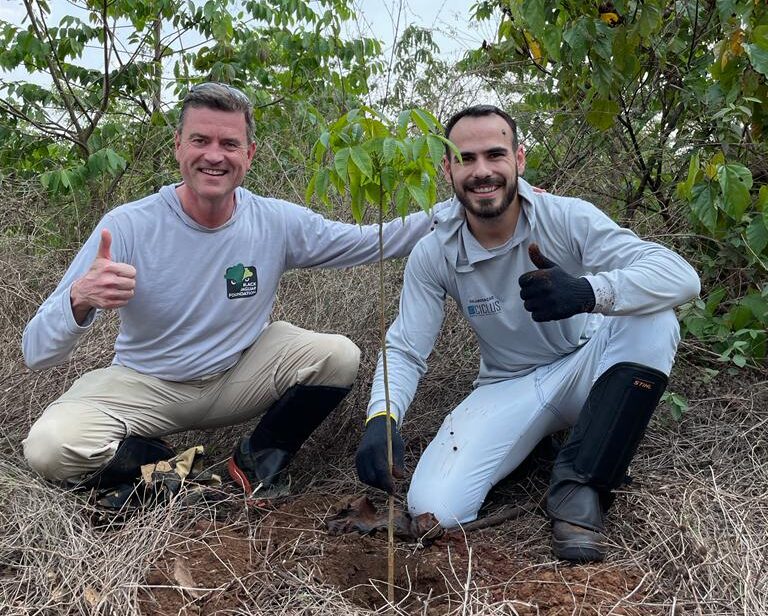
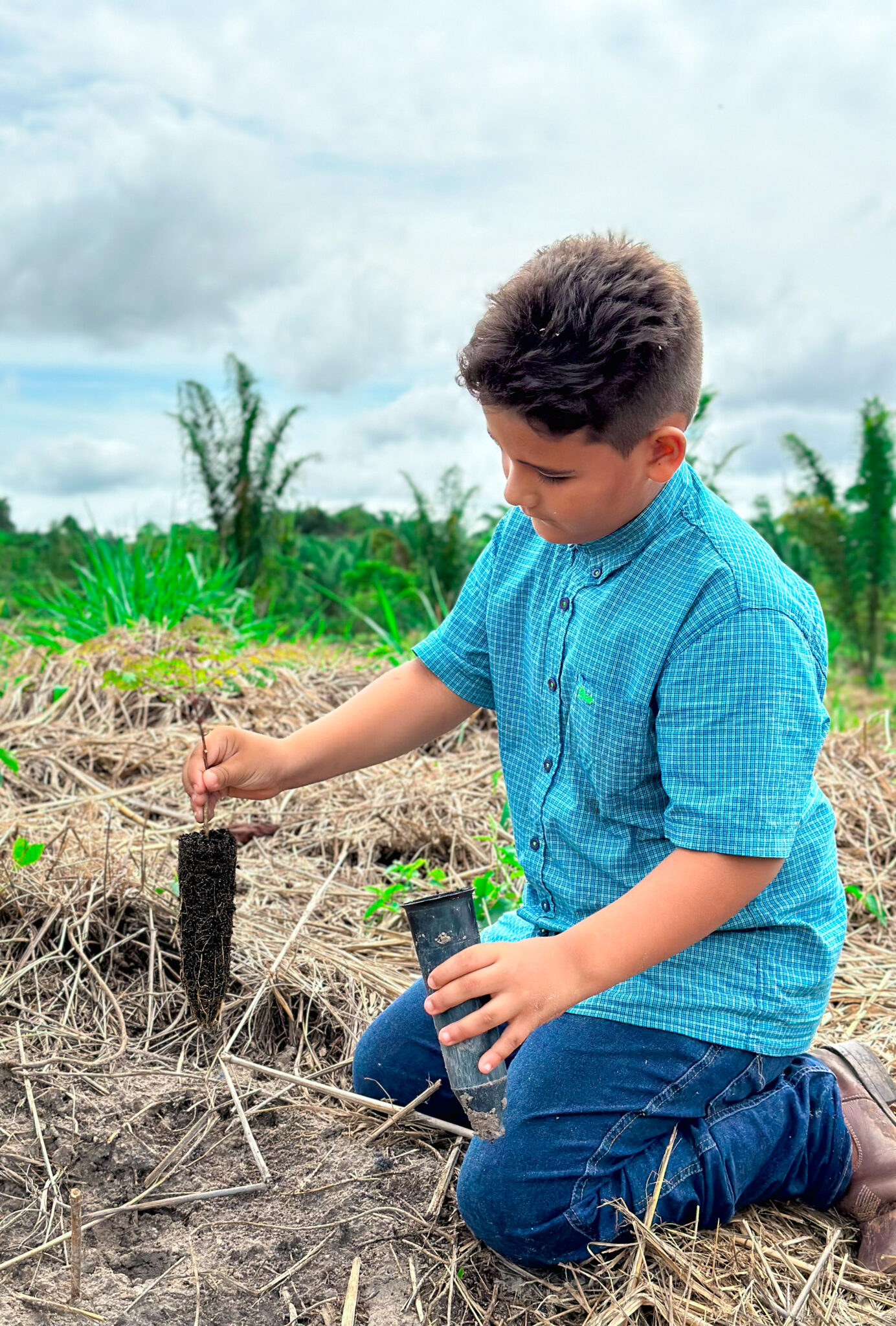
Ben & Tainan Field
Signs of return
The Black Jaguar Foundation is now much more than just hope and plans for the future.
Nature shows.
“What was barren land five years ago is now forest bursting with life,” Valks says.
Wildlife cameras document returning species. Birds disperse seeds into newly planted areas. Microclimates shift as canopy cover increases. Soil moisture improves.
“Planting trees is the beginning. Then nature takes over.”
Restoration is designed to initiate ecological processes, not replace them. Over time, maintenance requirements decline as ecosystems stabilise.
“This is long-term transition. You cannot transform landscapes in three or five years.”
By 2030, the foundation aims to reach first milestone of 10 million native trees planted, restore 6,000 hectares and operate three regional hubs with an annual production capacity of three million seedlings. Helping nature. One seed at a time.
History of the Black Jaguar Foundation:
The Black Jaguar Foundation mission began in 2009, when Ben Valks travelled to the Amazon. He wanted to pursue a lifelong dream: seeing a black jaguar in the wild.
“I travelled 10,000 kilometres and made several serious attempts with guides. I spent days perched high in trees but never saw one. I still haven’t, in its natural habitat. The black jaguar, though, became the symbol of what I did see: massive destruction of nature. That’s why I named my foundation the Black Jaguar Foundation.”
What shocked Ben was the extent of deforestation in the Amazon.
“Huge swathes of forest had been cleared for soy. My guide and I were stunned by what we saw. We had planned a four-day trip, but after only nine hours we were already at our destination—everything had been destroyed. I couldn’t ignore it. I decided I had to act.”
Inspired by the powerful documentary ‘HOME’ by Yann Arthus-Bertrand and its message that ‘we all have the power to change’, Ben has since devoted his life to restoring the Amazon rainforest and Cerrado savanna through the Black Jaguar Foundation.
Learn more on:
https://www.black-jaguar.org/about/#story and https://www.linkedin.com/in/ben-valks/