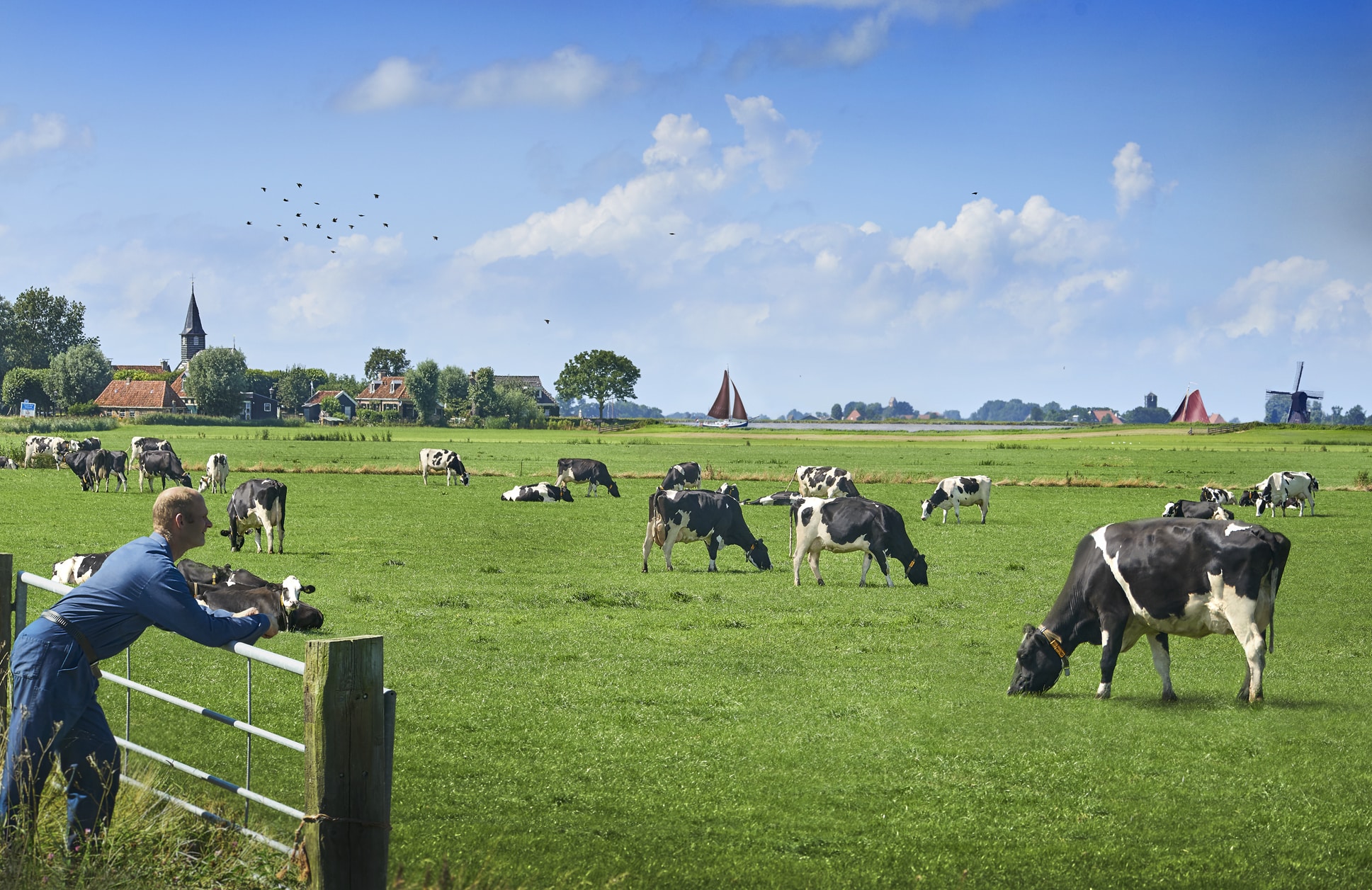
Few companies embody the connection between farming, food and nature as clearly as FrieslandCampina. Shaped by more than 150 years of cooperative tradition, the company today unites around 14,000-member dairy farmers across the Netherlands, Germany and Belgium. The company was established in 2008 through a merger between Friesland Foods and Campina. Both were long standing Dutch dairy cooperatives. https://www.frieslandcampina.com/.
Headquartered in Amersfoort, the Netherlands, FrieslandCampina operates in over 30 countries and serves consumers in more than 100 markets worldwide. Guided by its purpose, nourishing by nature, https://www.frieslandcampina.com/about-us/purpose/ the company aims to provide better nutrition for the world while creating a positive impact for farmers, society and the planet.
“We believe that when we take care of nature, nature takes care of us,” says Guus van Laarhoven, Regenerative Agriculture Manager, FrieslandCampina.
“Our aim is to achieve a net positive impact on nature by reducing our negative impacts and increasing our positive impacts — from grass to glass.”
From Grass to Glass
FrieslandCampina’s sustainability framework rests on three pillars — Nutrition, Planet and People. The cooperative’s approach to nature is both systemic and practical, linking soil, water, animals, and farmers in one circular model.
“Nourishing by nature is more than a slogan,” van Laarhoven explains.
“It captures the idea that everything we do, from how we grow the grass to how we make the milk, is connected to the health of our ecosystems.”
Nature, he notes, is not treated as a separate theme but as the foundation of long-term dairy resilience.
The Foqus Planet Programme and the “Foqus 5”
Central to FrieslandCampina’s approach is its Foqus planet programme, a quality and sustainability system that translates ecological performance into tangible results at farm level. https://www.frieslandcampina.com/owned-by-farmers/foqus-planet/.
Together with WWF Netherlands and Rabobank, FrieslandCampina developed the Biodiversity Monitor for Dairy, which measures biodiversity performance across all member farms. Through the Annual Nutrient Cycle Assessment, progress across all indicators is monitored for each farm, each year.
“Through Foqus planet, farmers receive financial premiums for measurable results in biodiversity, climate and animal welfare,” says van Laarhoven. In 2025, member farmers of FrieslandCampina received a total of 190 million euros for their sustainability efforts in 2024.
“We turn data into practical support through workshops, advisory tools and peer learning.”
For example, the “Foqus 5” defines five practical on-farm measures designed to strengthen biodiversity, reduce emissions and improve animal welfare:
- Optimising protein in animal feed.
- Increasing fresh grass intake.
- Using herb-rich grasslands and clover mixtures.
- Extending cow longevity.
- Improving the quality of homegrown roughage.
Each of these contributes to lower emissions, healthier soils and more diverse ecosystems. Through work shops, videos and sharing experiences from fellow member farmers, FrieslandCampina inspires and supports farmers to apply these practices on their farms.
Regenerative Agriculture in Practice
One of FrieslandCampina’s most dynamic biodiversity projects is its regenerative agriculture collaboration with Lidl Netherlands and ReGeNL. https://www.frieslandcampina.com/news/lidl-frieslandcampina-and-regenl-join-forces-in-innovative-pilot-for-regenerative-agriculture/.
The initiative connects 30 dairy farmers across the Netherlands, Belgium and Germany, as part of a larger study group of 60 member dairy farmers, in long-term learning groups to explore regenerative methods, test their impact on soil, biodiversity and profitability, and share results transparently. ReGeNL — a Dutch knowledge platform that promotes regenerative agriculture through research, education and farmer engagement — supports the project by providing expertise, tools and guidance to help farmers apply regenerative principles in practice.
“What these dairy farmers have in common is the motivation to explore together what it means to farm regeneratively and what the impact is on the farm,” says van Laarhoven.
The project provides practical insights into how regenerative farming can enhance biodiversity, reduce nutrient losses, and create more resilient production systems — while keeping farms economically viable.
Collaboration Across the Value Chain
As one of the world’s largest dairy cooperatives, FrieslandCampina knows that change depends on collective action.Its partnerships span the full value chain — from farmers and retailers to financiers, research institutions and food manufacturers.
“Our starting point is that the costs of transitioning our food system should not rest solely on the shoulders of our farmers but should be borne by the chain as a whole,” van Laarhoven explains.
Besides working with retailers such as Lidl Netherlands, FrieslandCampina also collaborates with partners like Rabobank, DSM_Firmenich and other major dairy players including Arla and Danone through the Future Fit Dairy Initiative.
This collaborative, pre-competitive effort aims to align regenerative practices across pilot farms and develop a shared monitoring framework tailored to the dairy sector.
“Only through collaboration can the loss of biodiversity be halted,” van Laarhoven says.
“No single actor can solve this challenge alone.”
A Longstanding Commitment
The cooperative’s structured approach to biodiversity dates back to 2018, when the Biodiversity Monitor for Dairy and financial rewards through Foqus planet were formally launched. The company recognised early that soil health, biodiversity and climate are deeply interconnected.
This mindset builds on FrieslandCampina’s century-old cooperative model, where progress for nature is inseparable from progress for people and communities.
The benefits of the biodiversity strategy reach far beyond the farm gate. Farmers see richer soils, healthier grasslands and improved water retention — all of which increase resilience against droughts and floods. Not only benefiting our farmers but also our customers. Resilient farming equals resilient sourcing.
“Working with nature makes our dairy farms and our value chain more resilient and therefore more future proof,” says van Laarhoven.
“This is valuable for dairy farmers in the cooperative, but also for our company and partners in the value chain.”
At the same time, measurable biodiversity data creates transparency for consumers and customers, helping them choose dairy products that actively contribute to ecosystem restoration.
Challenges and Trade-offs
Van Laarhoven is candid about the complexities involved.
“Biodiversity gains can take years, while market prices fluctuate,” he says and ad.
“We address this by linking biodiversity outcomes to clear rewards and by supporting farmers with data and knowledge. A challenge is that, unlike the financial results of carbon reduction, biodiversity outcomes are not yet easily quantifiable and comparable in accordance with global standards. This makes it more difficult to compare and build strong business cases.”
Progress, he adds, depends on aligning environmental ambitions with financial feasibility for farmers. Some measures that improve biodiversity — such as reducing fertiliser inputs or expanding herb-rich grasslands — may temporarily reduce yields or require upfront investments.
“That’s why we work to build understanding across the value chain,” he notes. “Retailers and consumers also have a role in rewarding products that contribute positively to nature.”
Balancing soil health, emissions, animal welfare and economic realities requires constant fine-tuning. The cooperative’s integrated approach — measuring impacts and sharing data across farms — helps manage these trade-offs while keeping biodiversity at the core of decision-making.
Lessons for Other Companies
Reflecting on FrieslandCampina’s journey, van Laarhoven highlights three key lessons:
“Take an integrated view — nature, climate, animal welfare and nutrition are connected, especially in a circular system like dairy farming.”
“Make it measurable and reward progress — link sustainability outcomes to tangible incentives for suppliers and partners.”
“Collaborate widely — no company can solve biodiversity loss alone. Working with farmers, NGOs, customers and financiers creates real impact and shared value.”