© Pelagos Ceteacean Research Institute_2021
Fewer than 200 sperm whales remain in the eastern Mediterranean. Their most important habitat, the Hellenic Trench, is crossed by around 30,000 ships a year. The collision is not only physical. Shipping also adds continuous noise to an ocean in which whales depend on sound to navigate, communicate and find prey.
The whales and the highway
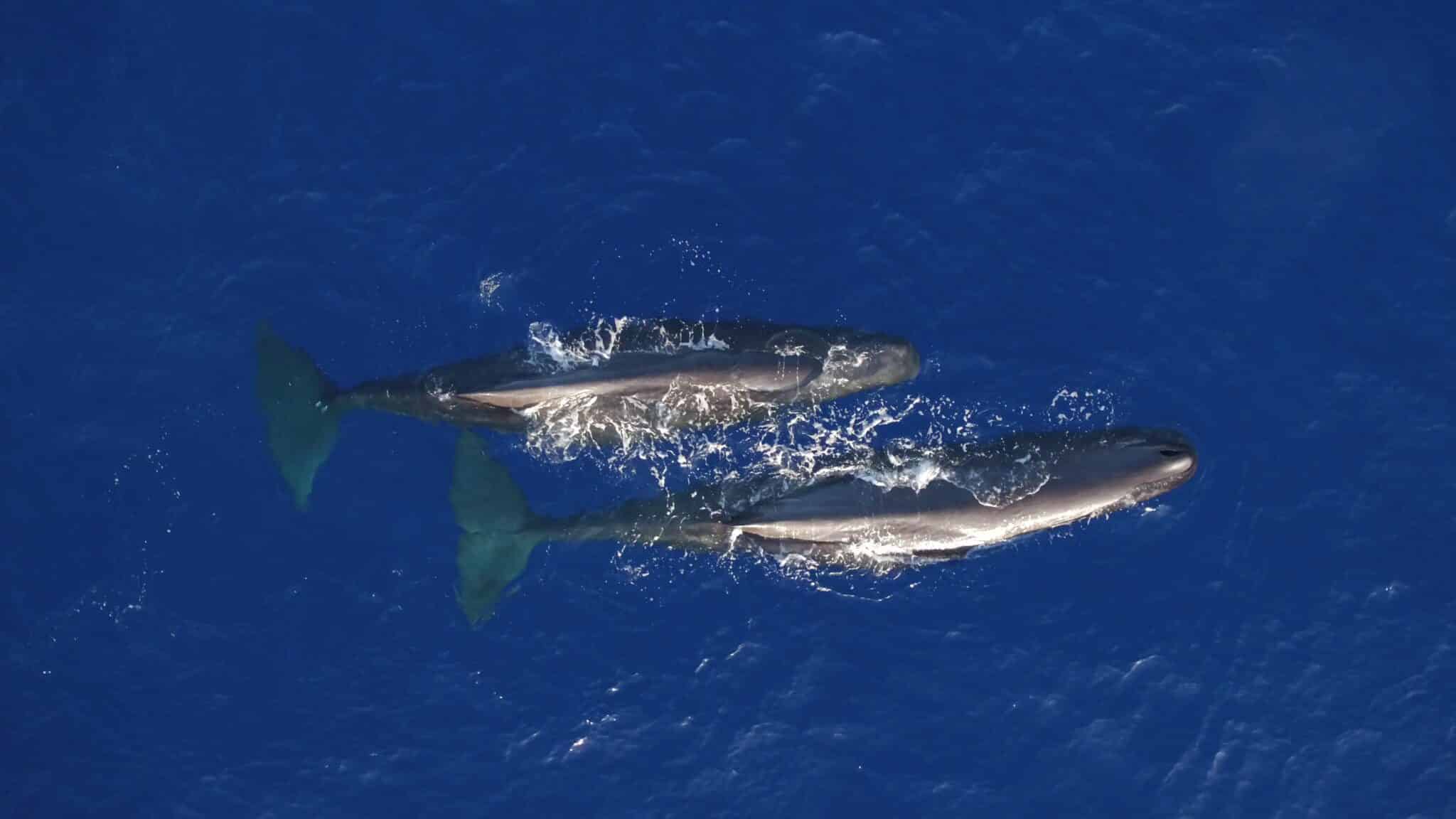
The Hellenic Trench is the deepest part of the Mediterranean and the most important habitat for the eastern Mediterranean’s sperm whales. Fewer than 200 are estimated to remain.
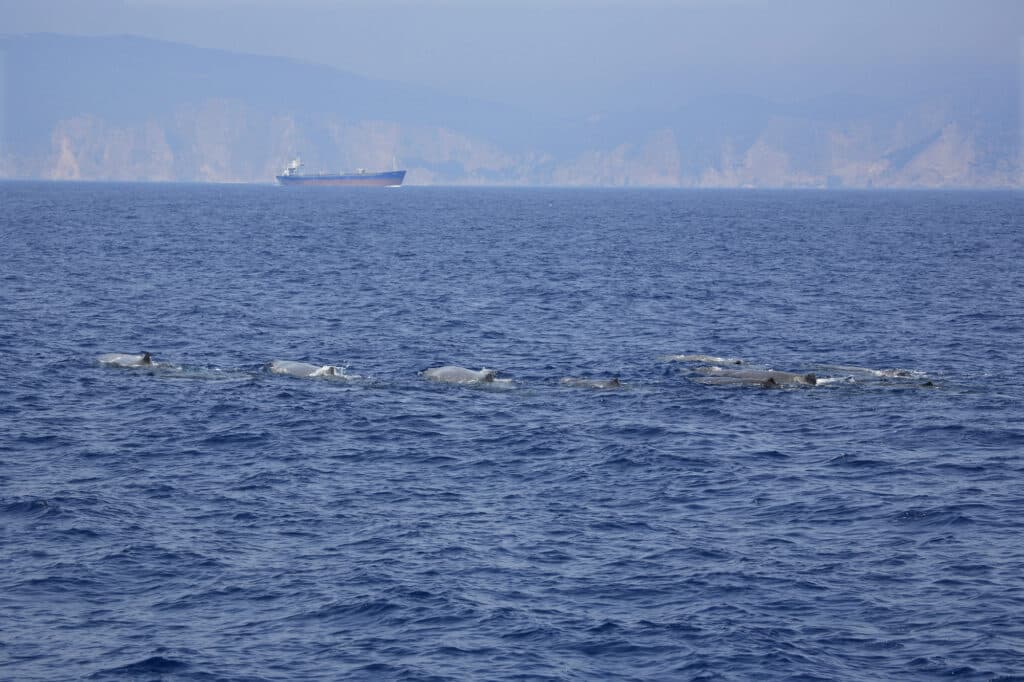
It is also a maritime highway. Around 30,000 ships cross the trench every year, travelling between the western Mediterranean and the Adriatic towards the Aegean and Black Seas.
For the whales, that overlap can be lethal.
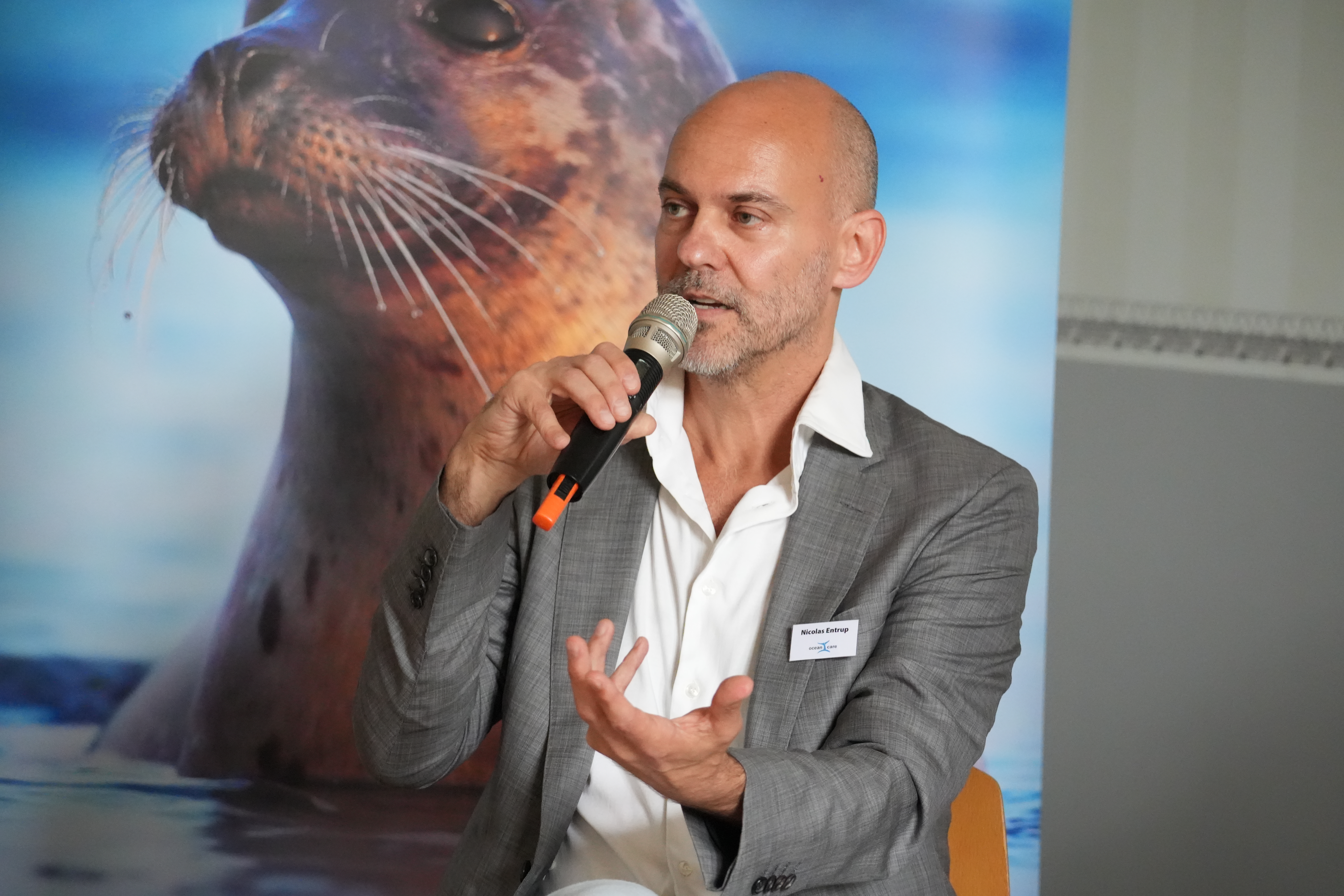
“The single most severe threat and mortality results from collisions,” says Nicolas Entrup, Director of International Relations at OceanCare.
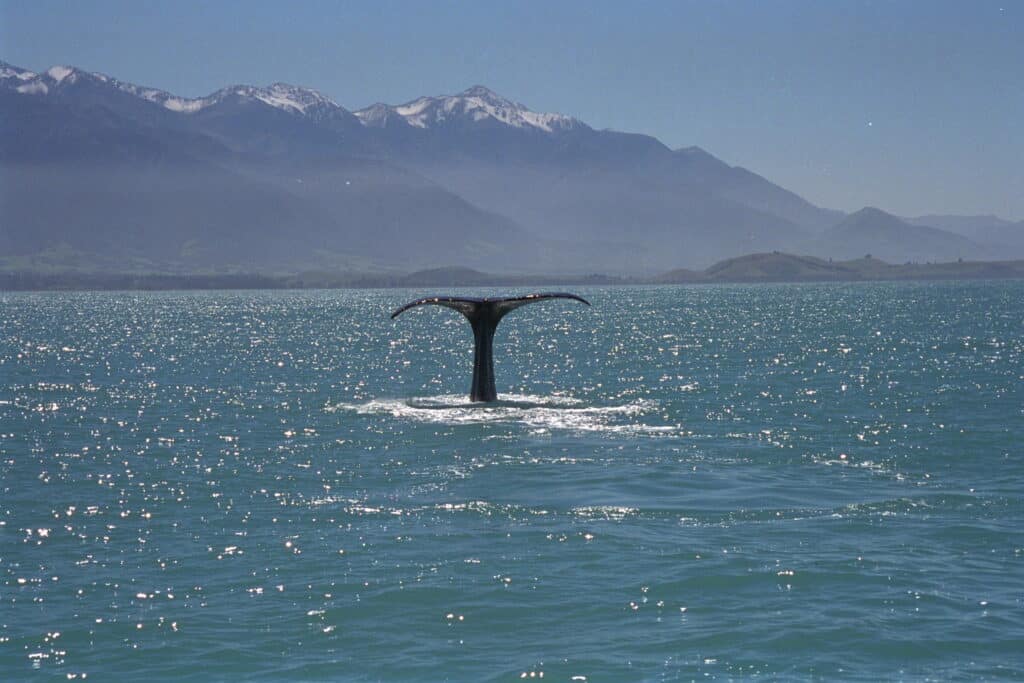
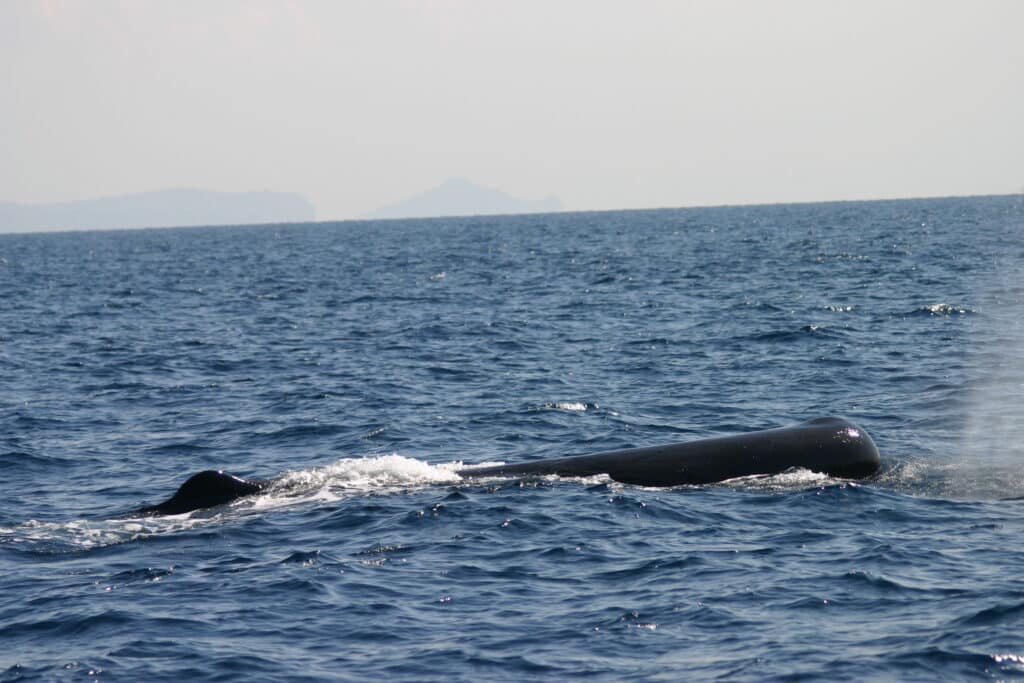
The risk is heightened by the way sperm whales live. They are deep divers, spending close to an hour below the surface before returning to breathe and recover. For 10 to 15 minutes they remain near the surface, exposed to vessels moving through the same space.
“Vessel speed is the main criteria for increasing the risk of striking a whale, especially as sperm whales rest on the surface after their long deep dives and therefore are at high risk whenever ships pass by,” Entrup says.
The benchmark he points to is 10 knots. Above that speed, the risk of a fatal collision rises sharply. When a large vessel hits a sperm whale, the outcome is often lethal.
© Pelagos Cetacean Research Institute_2025
What the numbers can and cannot tell us
The eastern Mediterranean population is so small that even a few deaths matter. But counting ship strikes is notoriously difficult.
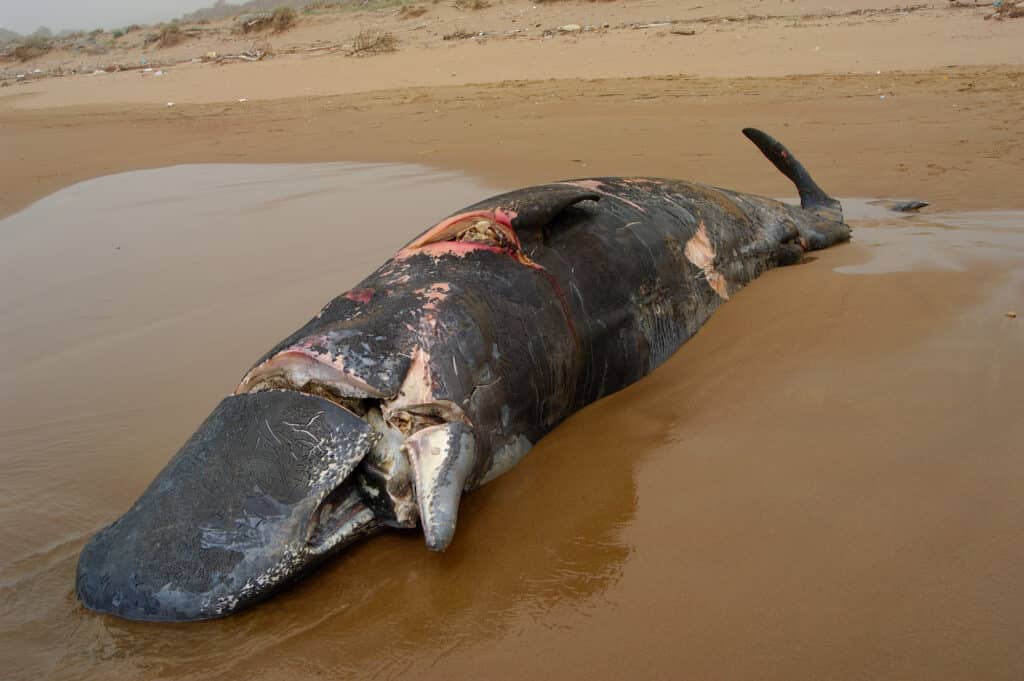
A 2019 scientific study of the Hellenic Trench recorded 30 sperm-whale strandings along Greek coasts between 1992 and 2017. Of the 24 cases that could be assessed, 13 had propeller marks or cuts that could only have been caused by ship strikes, and three more were possible collision victims. At least four of 181 live, photo-identified whales also carried deep wounds apparently caused by propellers.
The study put the reported ship-strike mortality in Greek waters at about one sperm whale a year. That sounds small until it is set against a population measured in only hundreds – and against the fact that the observed number is almost certainly an underestimate.
The International Whaling Commission cautions that there is no reliable global count of whales killed by vessels. Many collisions are never seen or reported, and carcasses may sink before reaching shore. For the same reason, there is no defensible global number for how many whales are affected by shipping noise.
The uncertainty is therefore part of the story rather than a reason to ignore it. Recorded deaths show only the visible part of the collision problem, while noise exposure is even harder to translate into a count of individual animals.
An acoustic world
A ship does not have to hit a whale to alter the environment through which it travels.
Below the surface, commercial shipping produces a continuous stream of sound, much of it from cavitation, bubbles forming and collapsing around propeller blades. To humans travelling above the water, the effect is largely invisible. For marine animals, sound is part of the habitat itself.
“The ocean is an acoustic world and marine animals use sound to communicate, navigate, find prey, hide and so on,” Entrup says. “When sound becomes noise, it is evident that its impacts are vast.”
OceanCare’s work on underwater noise pollution stresses that the problem extends beyond whales and dolphins to fish and invertebrates. Entrup therefore describes noise as both a direct pressure on deep-diving sperm whales and an indirect one through effects on prey and habitat.
Not all underwater noise is the same. Shipping creates chronic, continuous noise. Other activities produce intense pulses.
© OceanCare_2009
The sound of a gun
One of the loudest examples comes from seismic surveys used to search for oil and gas beneath the seabed.
A seismic airgun is not a gun in the conventional sense. It is a device towed behind a survey vessel that releases compressed air into the water in powerful pulses. Arrays of airguns fire repeatedly, and the returning sound waves are measured to map geological layers beneath the seabed and identify structures that may contain oil or gas.
Entrup says these surveys can blast the water column with sound levels of up to 260 decibels every 10 to 15 seconds, around the clock, for weeks.
OceanCare argues that the consequences can include behavioural disruption, displacement and stress in whales and dolphins, and calls for an end to new offshore oil and gas exploration both because of the acoustic impact and because new fossil-fuel exploration runs counter to the energy transition.
“As we are faced with a climate crisis we call for a ban of new exploration activities which would be in line with the energy transition, as well as reducing the loudest manmade noise,” Entrup says.
One lever, three effects
For shipping, the most immediate intervention is much simpler: slow down.
“Marine traffic could be relatively easily regulated in a way to reduce its ecological footprint, e.g. by reducing vessel speed,” Entrup says. “This would also result in a reduction of ocean noise, greenhouse gases as well as collision risk.”
The same operational change therefore addresses three pressures at once. Lower speeds reduce the probability and lethality of a strike, reduce propeller noise and cut fuel use and greenhouse-gas emissions.
OceanCare describes vessel-speed reduction as the most cost-effective measure available to reduce shipping’s ecological footprint, and one that can be implemented immediately.
The unresolved question is whether it remains voluntary. The International Maritime Organization adopted guidelines on underwater noise in 2014 and revised them in 2023. They include technical and operational measures, including speed reduction. Entrup argues that voluntary uptake has been too weak.
“We need a mandatory regulation that may operate sector specific, but by doing so create a level playing field for the private sector.”
© Pelagos Cetacean Research Institute_2008
Moving the highway
Where geography allows it, another solution is even more direct. Move ships away from the whales.
OceanCare, IFAW, the Pelagos Cetacean Research Institute and WWF Greece have worked with shipping companies on rerouting. MSC became the first major shipping company to move its routes away from core sperm-whale habitat in 2022, and other operators have followed.
CMA CGM joined the rerouting effort in 2023, while DFDS combined route changes with lower speeds on relevant passages.
“This has been successful to a large extent,” Entrup says. “Still, a large amount of vessels still cross the whales habitat posing a severe risk.”
The significance is that protecting the habitat does not require closing a major transport corridor. Across much of the trench, relatively small course changes can substantially reduce the overlap between ships and whales.
When the route cannot move
There is one crucial stretch where rerouting is not feasible: between the Strait of Kythira and Cape Tainaron at the southern tip of the Peloponnese. Ships connecting the western Mediterranean with the Aegean and Black Seas must pass through.
Here the response is technological. SAvE Whales uses hydrophones on the seafloor to detect the distinctive clicks of sperm whales and locate them in real time. That information can warn approaching vessels, giving captains time to reduce speed or alter course.
The system is being developed with the Greek authorities, The Green Tank and scientific partners and is planned for permanent operation and handover to the Greek environmental agency by 2028.
For Entrup, it fills the gap left when the shipping lane itself cannot be moved.
“This, together with the alert system which leads to reduced speeds for the area where shipping traffic can not be changed, will provide a very positive protection scheme addressing collision risk reduction.”
© Pelagos Cetacean Research Institute_2009
From voluntary action to a different system
The Hellenic Trench turns an abstract biodiversity problem into a practical question of infrastructure.
A shipping route appears on a map as a line between ports. Under that line is a habitat. For the eastern Mediterranean sperm whale, the same deep waters that make the trench indispensable are part of a transport network connecting economies thousands of kilometres apart.
The measures described by Entrup do not depend on removing shipping from the Mediterranean. Where possible, routes can shift. Where they cannot, whales can be detected. Across both situations, lower speeds reduce several pressures simultaneously.
“Making vessel speed reduction mandatory, sector by sector, would address shipping’s noise, emissions and collision impacts at once,” Entrup says.
At the wider international level, OceanCare is also backing the High Ambition Coalition for a Quiet Ocean, launched at the 2025 UN Ocean Conference. Entrup’s two priorities are equally direct: ban new oil and gas exploration in the ocean and introduce mandatory, sector-specific vessel-speed reduction.
The sperm whale is the entry point. The larger question is how a global transport system behaves when its most efficient routes cross habitats that other species cannot simply leave.
In the Hellenic Trench, the options are already visible. Move the highway where possible, slow it down and listen to what is happening below the surface.
Fact box
Species focus: Eastern Mediterranean sperm whale (Physeter macrocephalus).
Status: The Mediterranean sperm whale subpopulation is classified as Endangered on the IUCN Red List, according to Entrup’s response.
Population: Fewer than 200 sperm whales are estimated to remain in the eastern Mediterranean.
Geographic focus: The Hellenic Trench, including the Strait of Kythira, Greece.
Shipping overlap: Around 30,000 ships cross the Hellenic Trench each year.
Recorded mortality: A 2019 study found about one reported sperm-whale ship-strike death per year in Greek waters; the authors and the IWC stress that observed strandings underestimate the true toll.
Main transport pressures: Ship strikes and continuous underwater noise from commercial shipping.
Key measures: Rerouting, lower vessel speeds, real-time acoustic detection through SAvE Whales and stronger mandatory regulation.
Expert: Nicolas Entrup, Director of International Relations, OceanCare.